
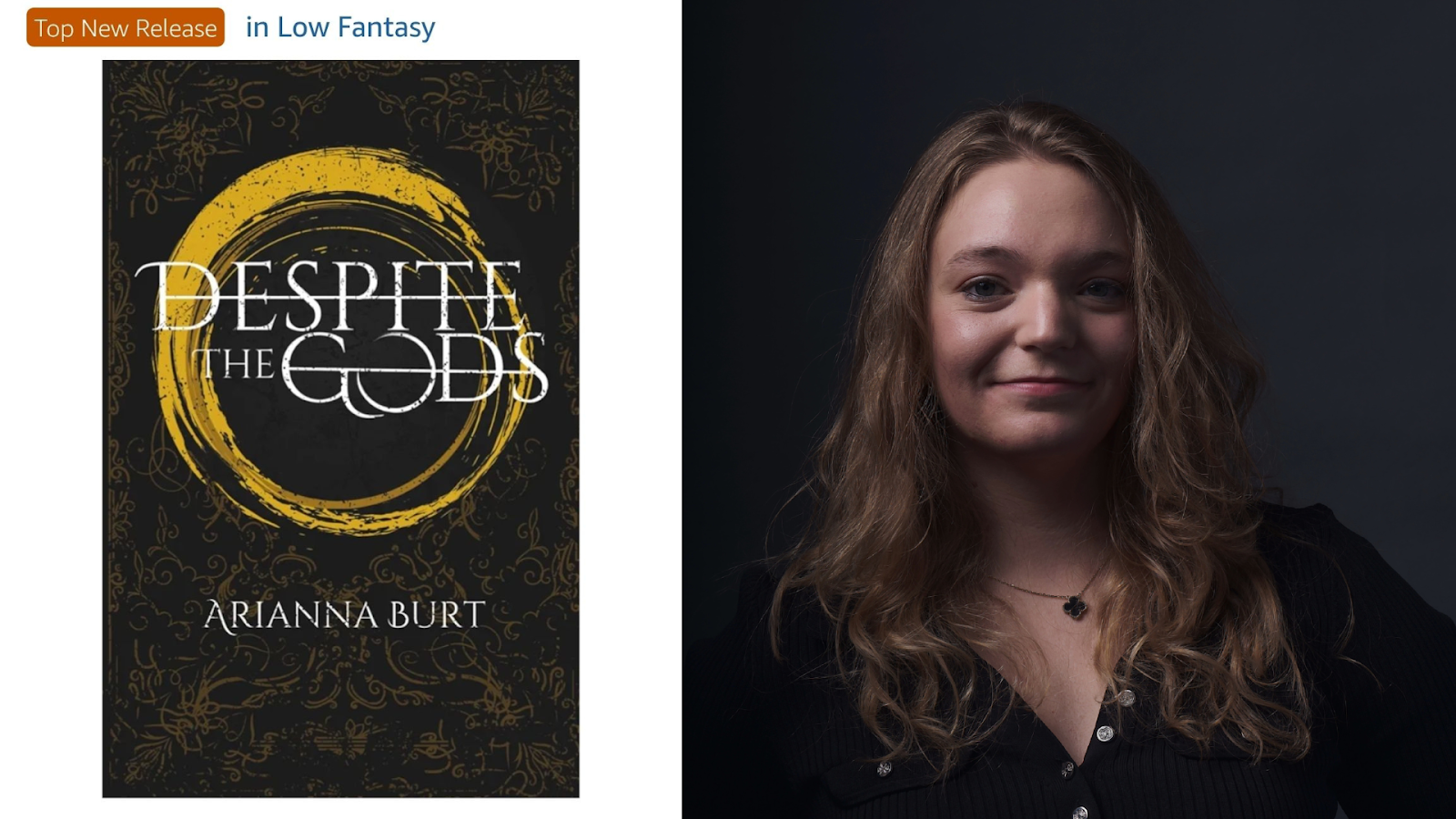
Arianna Burt catapulted from behind-the-scenes film producer to bestselling author with her debut fantasy novel ‘Despite the Gods,’ which claimed the #1 spot on Amazon’s fantasy charts. Now she channels that literary momentum into co-writing ‘The Prince, the Sister, and the Serpent,’ a Greek mythology epic set for 2026 production. Her decade at Egerton Crescent Productions provided the foundation for this dual success, proving that creative talent often builds quietly before breaking into public view.
Pandemic Project Becomes Publishing Triumph
‘Despite the Gods’ sprouted from a single line of dialogue during the COVID-19 lockdown, when Burt found herself with unexpected time to explore dormant creative impulses. The story expanded into an epic dark fantasy centering on Rhekran, a feared warrior known as ‘the God Killer,’ whose destiny becomes entangled with an untested Echohand within the mysterious Loom. Burt’s character philosophy drives the narrative: “I wanted to show that characters can be powerful and happen to be female, not powerful despite being female.”
Her English studies at Montana State University shaped a writing style that blends influences from fantasy masters Robin Hobb, Brandon Sanderson, and Patrick Rothfuss with literary voices like Cormac McCarthy and Carlos Ruiz Zafón. The novel marks her second Amazon bestseller in 18 months, establishing her transition from producer to published author. Character-driven storytelling remains her signature, building worlds around people rather than forcing personalities into predetermined settings.
The book’s success validates her belief that authentic character development resonates more powerfully than spectacle alone. Readers connected with Rhekran’s journey precisely because Burt avoided traditional gender tropes, creating a protagonist whose strength feels natural rather than manufactured for modern sensibilities.
Greek Mythology Meets Modern Cinema
‘The Prince, the Sister, and the Serpent’ represents Burt’s most ambitious screenplay, co-written with director Omar Parker for Egerton Crescent Productions. The film explores Cadmus, the legendary Phoenician prince whose quest to rescue his sister Europa from Zeus triggers a divine curse that shadows his bloodline for generations. Production begins summer 2026, with casting already underway featuring Constantine Gregory as The Narrator, Nicolas J Greco as Poseidon, and Emily McGonagle as Hera.
Burt’s research methodology mirrors her novel process: immersive, tactile, and deeply personal. Mediterranean research trips allowed her to absorb the landscapes and cultures that inform the screenplay. “Researching on the ground was essential,” she explains. “You cannot capture the atmosphere of a place without spending time in it, listening to people, and letting the environment tell its own story.”
The dragon-slaying adventure weaves through Thebes’ founding, featuring mythological figures including Zeus, Poseidon, and Hera alongside mortal characters. Burt serves as both screenwriter and executive producer, working closely with Omar Parker, Charles Burt, and Abraham Mejorado to maintain creative vision while managing practical production demands.
Creative Leadership at Egerton Crescent Productions
Since 2015, Burt has operated as a creative architect at Egerton Crescent Productions, shaping narratives from conception through completion. The company earned prestigious recognition when Cannes embraced shorts ‘Damiana’ and ‘Eden,’ while Sundance welcomed ‘Ultraviolet’ and ‘Mud’ into their competitive lineups. These festival victories proved that ECP’s creative instincts could compete on the global stage, with Burt’s story sense helping guide those decisions.
Her media savvy emerged alongside her production work, culminating in ‘Side Quest,’ a travel series that exploded across platforms with millions of views. The show’s success demonstrated her understanding of audience engagement beyond traditional film circles. While Charles Burt and Omar Parker became the most notable visible faces, accumulating over one million followers each, Arianna Burt’s strategic thinking powered the content that made those numbers possible.
Screenplay writing presents different challenges than novel crafting, particularly for mythology-rich projects like the Cadmus story. “The hardest part of moving from novel writing to screenwriting has been cutting back on the big, layered worldbuilding I love—you don’t get as much time for that on screen,” she reveals. Yet she refuses to sacrifice emotional depth for brevity, insisting that characters must feel authentic even within tight cinematic boundaries.
Writing rituals anchor her work across all formats. Longhand drafts capture initial character conversations before digital revisions polish scenes with input from her creative circle. When inspiration stalls, she chooses between complete disconnection for a mental reset or intensive research sessions, where historical details often unlock narrative breakthroughs. Her personal Instagram audience has grown beyond 400,000, creating direct reader connections that inform her storytelling choices.
“A writer-producer whose stories really connect with people, whether on the page or on screen” remains her professional goal. ‘The Prince, the Sister, and the Serpent’ exemplifies this vision, blending her production experience with newfound literary confidence. Her decade of behind-the-scenes work now supports her public creative presence, proving that industry knowledge and artistic vision can merge into compelling storytelling across multiple platforms.