
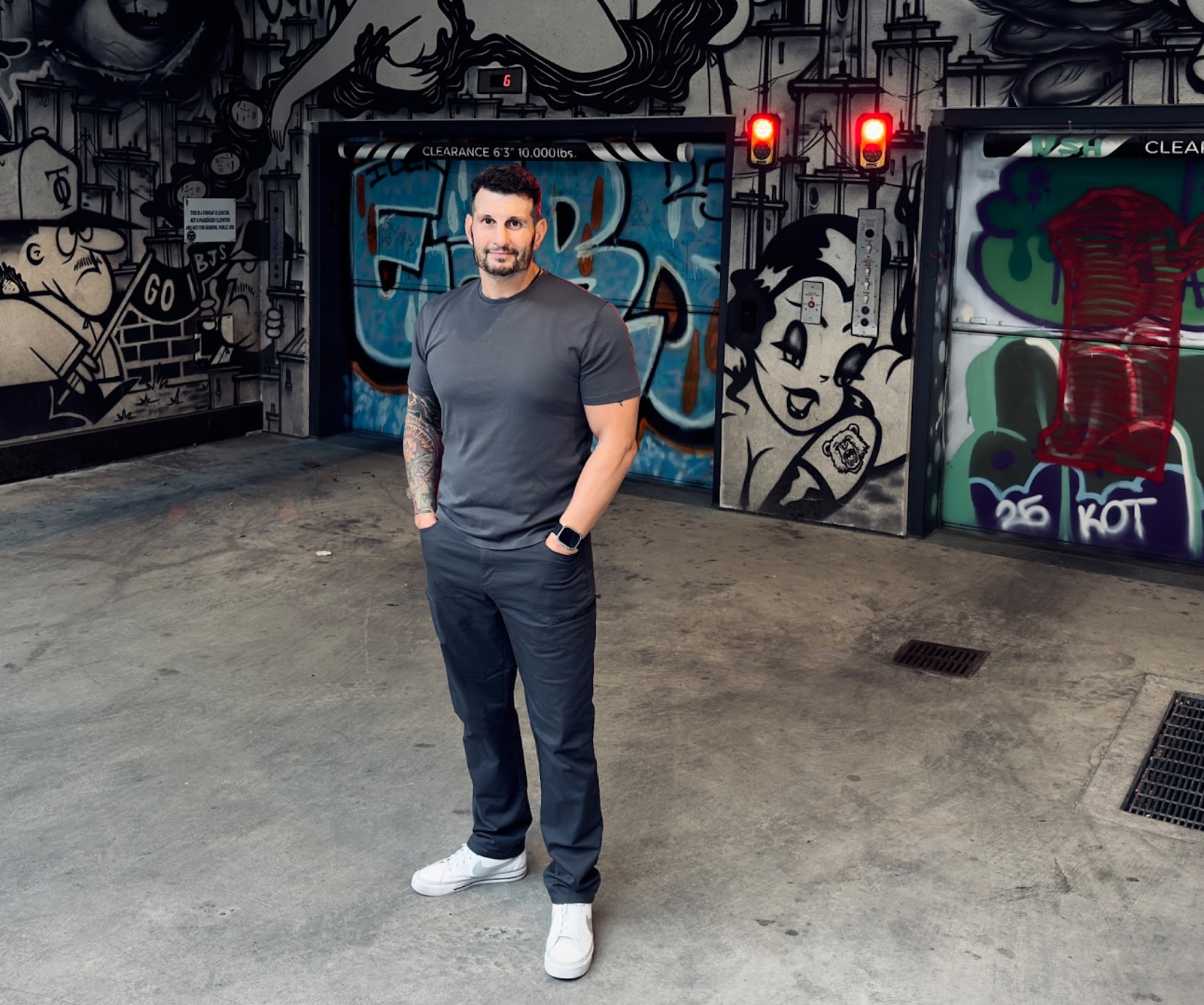
Known to many in the industry simply as “Rizz,” Daniel Rizzuto has followed a path through film that resists easy labels; he is equal parts performer, storyteller, and creative partner. With a career that spans performance, design, direction, and ghostwriting, he’s a filmmaker driven not by genre, but by the emotional weight a story can carry.
From his early days in the stunt world—both performing and coordinating—Rizzuto has long been drawn to the mechanics of story as much as the choreography of movement. His creative evolution feels less like a pivot and more like a gradual unveiling. “Everything I’ve done has led me to where I am now,” he says. “But the goal was never just action. It was meaning.”
That intention is front and center in his emerging collaboration with veteran screenwriter and producer Chad Law (“Hero Wanted,” “Six Bullets,” “Daylight’s End”), who has tapped Rizzuto to direct one of his latest character driven thrillers. “Chad’s scripts have this emotional residue to them,” Rizzuto says. “They don’t just hit, they stay with you.” Their partnership represents a shared belief in prioritizing story before spectacle.
While his resume includes contributions to blockbuster properties across Marvel, Amazon, Apple, Sony, and Warner Brothers, Rizzuto views these not as badges of honor but chapters in a bigger journey. “I grew up on films like ‘Good Will Hunting.’ Stories that changed your perspectives. That’s the kind of impact I want to leave behind,” he remarks.
That motivation fuels “Mancini,” a deeply personal drama Rizzuto is currently writing. Inspired by stories of fractured relationships and quiet redemption, it’s a film “about broken people, second chances at life, and showing up for the people we love.” He adds, “It’s the most vulnerable and painful thing I’ve written to date. It’s about a former fighter who discovers he has a son, and neither of them know how to love properly. It’s about fighting for more than yourself.” It’s a film he calls his own “Good Will Hunting.”

The cultural landscape we’re living through—polarized, disillusioned, digital—only intensifies his desire to tell stories that dig deeper. “Film can still change how we see things,” he says. “And if you reach the right people at the right time, it can change how they think.” Beyond his own projects, Rizzuto has quietly worked as a ghostwriter for several Hollywood names, helping shape emotional arcs and character beats from behind the scenes. He’s quick to deflect credit but acknowledges how those experiences have sharpened his narrative instincts.
His draw towards directing began during his early time protecting celebrities like Jessica Alba on the set of Dark Angel. Watching the rhythm of set life sparked a creative awakening that eventually pulled him toward camera work, fight choreography, stunt coordinating, and ultimately the director’s chair.
He’s worked with an impressive roster: Jason Momoa, Tom Hardy, Nick Cage, Karl Urban, Frank Grillo, Lesley-Ann Brant, Lewis Tan, Katheryn Winnick, Iko Uwais, JuJu Chan, to name a few. This he does always with the same guiding principle: to make actors look great while never stealing focus from the story. “You don’t just choreograph fights,” he says. “You choreograph emotion. That’s how the audience connects.” Of all the actors he’s collaborated with, he says Lesley-Ann Brant stands out as one of the toughest. “No one trained as hard as she did. Her level of determination is truly rare,” Rizzuto recalls from their time on the first season of Lucifer.
That principle anchored his first feature, “Torn: Dark Bullets,” shot in just 15 days on a shoestring micro budget. Focused more on emotional reckoning than physical confrontation, the film addressed issues of police violence and racial trauma. It won over a dozen awards and was distributed on Amazon Prime and UrbanFlix TV.

His next major effort, “JAKA,” a pilot project, was filmed in Indonesia and co-produced with partner Elfina Luk and co-writer Josh Mazerolle. Blending Southeast Asian energy with grounded action, the pilot had originally been greenlit. But after the SAG strikes and a corporate restructure at the company backing it, the project was shelved due to financial issues. Still, it’s now being reviewed by multiple major studios and gaining momentum.
In parallel, Rizzuto co-founded Road Dog Entertainment with Luk, a production company dedicated to bold, emotional filmmaking. He’s also behind The Reaction Lab, a creative sandbox for testing new tools and techniques in action design.
When asked about a standout experience, Rizz doesn’t mention awards or big names. He points instead to House of David, a recent production on Amazon he calls “one of the most expressive and collaborative sets” he’s been on, crediting longtime friend and collaborator Kimani Ray Smith for setting that tone.
“A director’s job isn’t to dictate,” Rizzuto says. “It’s to listen. You guide the story by trusting the people you cast to tell it with you. That’s when the magic happens.”
A member of DGA, DGC, SAG, UBCP, and ACTRA, Rizzuto brings to the table a rare blend of experience, passion, and purpose. He’s not chasing trends. He’s chasing truth. And in today’s fractured world, that might be the most cinematic goal of all.