

The deaths we cannot explain often become the catalysts for our most profound innovations. For Pulsetto CEO and co-founder Povilas Sabaliauskas, that catalyst was his father’s death from unexplained medical causes, a loss that left questions unanswered. Meanwhile, co-founder Vitalijus Majorovas watched helplessly as his wife battled cluster headaches that defied every conventional treatment doctors could offer. These weren’t abstract medical challenges; they were personal crises that exposed the limitations of traditional healthcare when it comes to conditions rooted in our nervous system’s response to modern life.
These parallel experiences with medical systems that offered no answers would become the emotional foundation for something larger. Their journeys through medical frustration would eventually converge into something tangible: Pulsetto, a company now recognized with a 2025 Global Recognition Award for its development of medical-grade vagus nerve stimulation into an accessible consumer device that addresses the growing global mental health crisis. Born from personal tragedy and the universal human desire to ease suffering, what emerged was a device targeting stress through direct bilateral stimulation of the vagus nerve. The company’s trajectory reflects notable market validation, with 130,000 active users and revenue performance reaching €10.9 million in the first half of 2025 alone, surpassing the entire 2024 performance of €10 million within six months.
The award evaluation employs the Rasch model to establish linear measurement scales, allowing precise comparisons across excellence categories. This methodology identified Pulsetto’s strong performance in innovation. The company achieved the highest scoring level across six innovation criteria: novelty and originality, market impact, technological advancement, addressing global challenges, adoption rate, and disruption of existing paradigms. This recognition validates the science behind the device and its real-world impact, making Pulsetto a significant player in accessible neurotechnology solutions.
A Device Built For Real Life
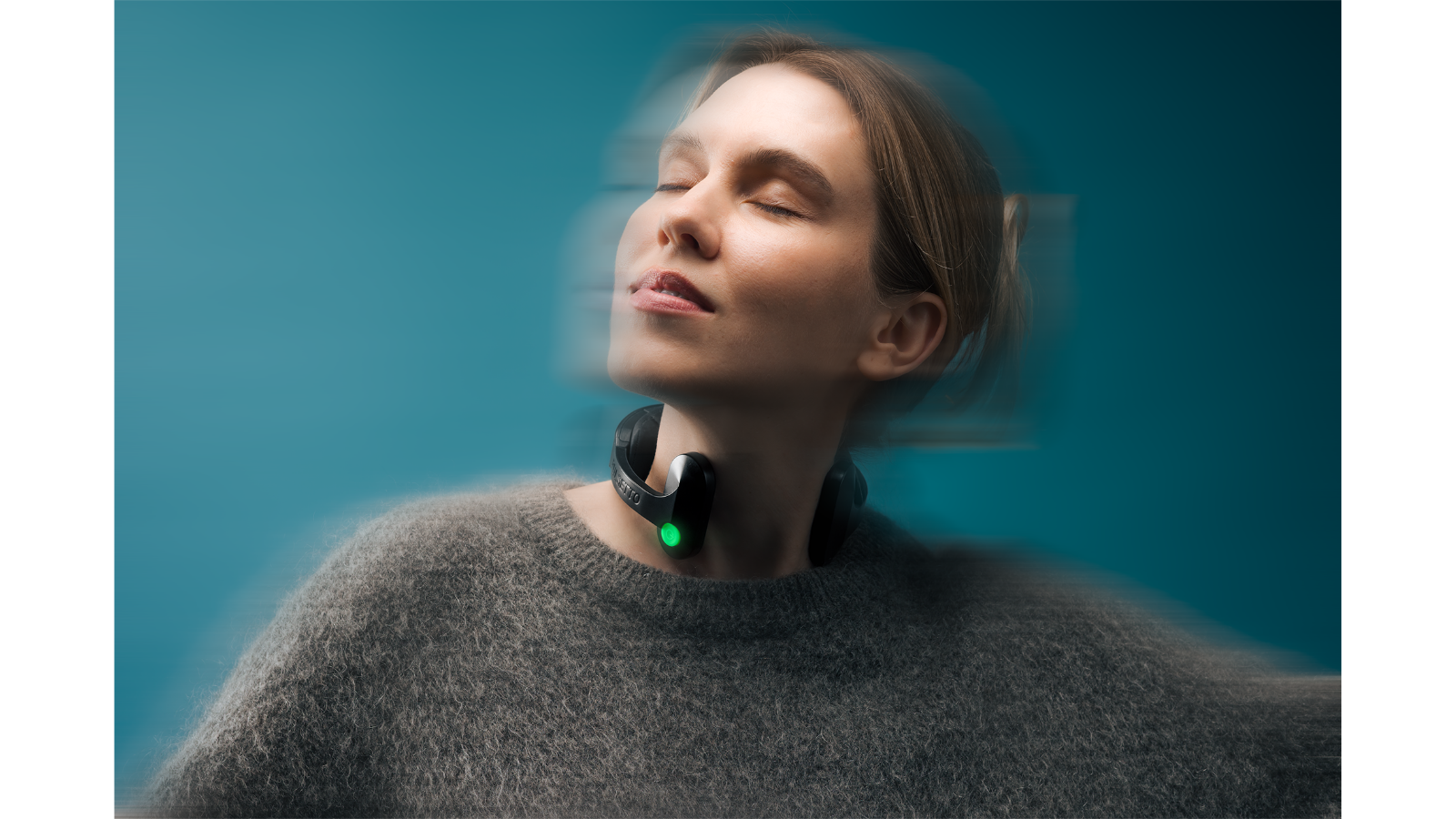
The device landscape has been shifting toward hands-free solutions that fit into daily life, and Pulsetto FIT represents this evolution in stress management technology. The device wraps around the neck with magnetically attached padding in three sizes, designed to fit different body types comfortably. Each session lasts just four minutes, a brief pause in the day that activates the body’s natural relaxation response, shifting users from heightened stress to calm. What sets this apart from earlier devices is its simplicity: no handheld controllers, no complex setup, just a wearable that works bilaterally on both sides of the vagus nerve simultaneously. The company has distinguished itself through its hands-free wearable design for cervical vagus nerve stimulation, currently representing the sole bilateral solution available on the consumer market.
Americans are burning out, and the numbers tell a stark story. Antidepressant utilization in Western nations has escalated 66 percent over six years, and stress drives millions toward coping mechanisms that compound the problem: 40 percent of individuals resort to alcohol and 38 percent to smoking for stress mitigation. The question hanging over the wellness and tech industries has become increasingly urgent: Can technology offer relief without side effects or dependencies? For Sabaliauskas and Majorovas, the answer was clear: yes. Not as an abstract possibility, but as a tangible solution born from watching people they loved suffer. The experience itself is designed for modern life. Users wear the device for four minutes, selecting from modes targeting stress, anxiety, burnout, sleep, or pain relief. The application offers five preset stimulation modes with nine intensity gradations, allowing users to tailor their experience to individual requirements and tolerance thresholds.
The Science Behind The Relief
Pulsetto completed clinical trials demonstrating notable health improvements, with results indicating significant improvements in stress, mood, and sleep. Specifically, depression symptoms decreased by 56 percent, anxiety reduced by 45 percent, and sleep quality improved by 41 percent on standardized clinical assessments. Company data indicates 86 percent of users experienced reduced anxiety following two weeks of consistent use. After 15 sessions with the device, 64.5 percent of users experienced reductions in anxiety and stress, providing sustained relief in daily functioning. The mechanism is rooted in how our bodies naturally regulate stress. Research evidence suggests bilateral transcutaneous vagus nerve stimulation may alleviate physiological stress indicators and enhance self-reported symptoms related to depression, anxiety, and sleep disturbances through parasympathetic nervous system activation.
Vagus nerve stimulation activates the parasympathetic nervous system, resulting in a decrease in heart rate and an increase in heart rate variability within two to four weeks, while simultaneously reducing cortisol levels, which are directly correlated with stress states. What this means in practice: the body learns to find its way back to calm, not through medication, but through gentle electrical pulses that work with the nervous system’s own pathways. Pulsetto has established global distribution in over 70 countries, and has launched retail operations in London (Selfridges Smartech, Boots) and New York (TM: RW in Times Square, Walmart). This expansion reflects a broader cultural shift, as the rising demand for tech-enabled stress solutions and wellness is becoming more widely accepted, driving the adoption of accessible mental health tools. The company’s Second-quarter 2025 revenue reached €6.65 million, representing 55.61 percent growth over the first quarter and confirming consumer interest in non-invasive neurotechnology solutions that combine clinical efficacy with everyday convenience.
A New Standard For Wellness
Pulsetto’s achievement represents a significant shift in neurotechnology accessibility, converting a clinical intervention into a product used regularly by over 60,000 individuals, demonstrating that sophisticated nervous system regulation can be rendered accessible through considered design principles. Clinical evidence, user adoption metrics, and revenue growth validate the market demand for non-pharmaceutical stress management tools that offer measurable physiological benefits without the adverse effects associated with traditional pharmaceutical interventions. What began as a deeply personal struggle has become the driving force behind a company now serving over 130,000 people worldwide. When Sabaliauskas and Majorovas watched their loved ones suffer through anxiety and stress without effective solutions, they saw a gap that neither medication nor existing treatments could adequately fill. In that gap, they found their purpose. Their response was to build something different.
Alex Sterling, spokesperson for Global Recognition Awards, acknowledged the company’s impact, observing that “Pulsetto has demonstrated that consumer product design and scientific integrity are not mutually exclusive concepts, and the company’s ability to scale a neurotechnology solution while maintaining scientific integrity sets a new standard for the wellness technology sector.” The recognition feels earned. Not just for the innovation itself, but for what it represents. The founders have demonstrated that technology rooted in personal experience can serve millions facing similar struggles. Their work represents more than technical achievement. It reflects a growing recognition that effective wellness solutions must balance scientific evidence with a genuine understanding of human needs. Pulsetto’s recognition through this award acknowledges the company’s success in democratizing previously inaccessible medical technology for everyday consumers seeking evidence-based alternatives to pharmaceutical stress management, changing what was once confined to clinical settings into a tool for daily use.