

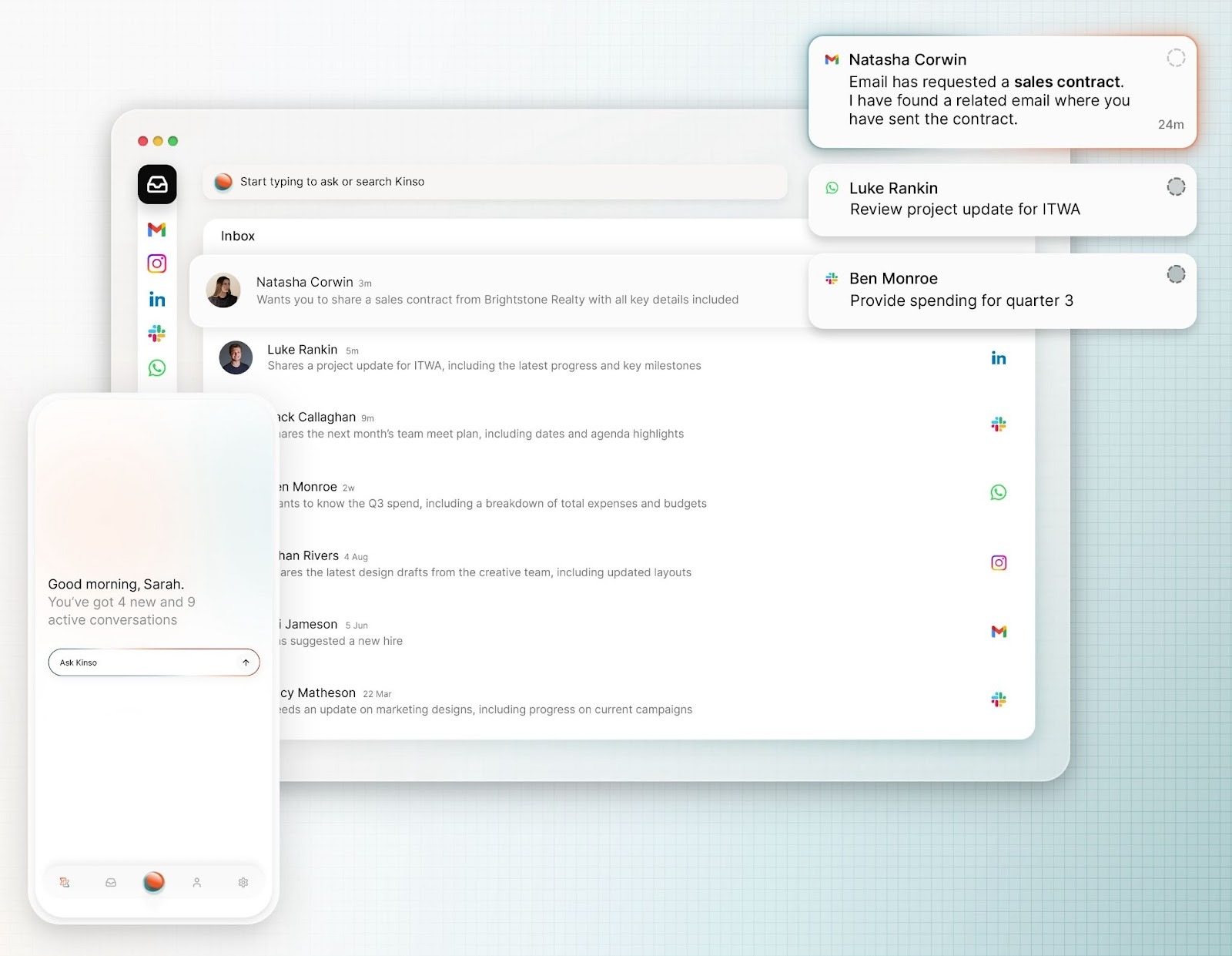
In many high‑growth companies, mornings now begin with a quiet sense of dread. Email fills overnight. Slack channels light up. WhatsApp, SMS, LinkedIn, and calendar alerts compete for attention before the first meeting starts. Somewhere inside that swirl are a handful of messages that will shape the week: an investor probing runway, a customer hinting at churn, a candidate weighing another offer. The rest is noise. The difficulty lies not in receiving information, but in deciding what deserves a response first.
Kinso, a young company founded by brothers Frank and Jacques Greeff, has built its product around that decision point. Rather than trying to replace existing tools, it connects to them and attempts to reorder the entire flow of communication so that high‑stakes conversations rise to the top. Its thesis is stark: in an era of exploding message volume, speed of response has become a decisive asset, but only when it is aimed at the right things.
When Every App Is Urgent
Modern executives rarely live in one inbox. Investors may send sensitive messages over email and follow up in encrypted chat. Customers open tickets in help desks, then escalate in social DMs. Internal decisions scatter across channels and private threads. Each system promotes its own idea of urgency through badges, banners, and alerts. Taken together, they produce a flattened field where everything appears equally important.
That flattening has real consequences. Leaders spend more time scanning and searching than deciding. They cycle between apps, trying to reconstruct context: what was promised, who is waiting, which risks are gathering. Traditional tactics—batching email, muting channels, building filters—offer partial relief but do not solve the deeper problem that no single tool sees the whole picture.
Kinso starts by accepting this fragmentation as a given. The company does not ask users to move conversations into a new platform. Instead, it connects to existing inboxes, chat systems, calendars, and contact lists, then ingests their contents into a unified view. Even at this basic level, the aim is not cosmetic consolidation. It is to create the conditions for a more meaningful sense of priority.
From Unified Inbox To “Opportunity Stack”
The core of Kinso’s approach is to treat messages and events as parts of a network rather than isolated items. A comment about contract terms in chat links back to the original proposal in email and to a calendar event about renewal. A note about hiring in a team channel connects to a social message from a candidate and to internal planning documents. By mapping these relationships, Kinso can present conversations as evolving threads instead of scattered fragments.
On top of this map, the system builds what it calls an opportunity‑focused view of the day. Instead of listing everything in order of arrival, it generates a ranked stack of threads that appear most likely to affect revenue, fundraising, hiring, or key relationships. A short message from a major customer can appear above a long internal update. A quiet question from a board member can outrank dozens of routine notifications.
The intent is to externalize the mental triage experienced operators already perform, but to do so at a scale that humans can no longer manage alone. When a user opens Kinso in the morning, the first screen is not a backlog of everything that came in overnight, but a set of conversations the system believes warrant immediate attention. The rest remains accessible, but it no longer defines the shape of the day.
Alongside ranking, Kinso offers fast reconstruction of context. Clicking into a thread can reveal related exchanges across channels and prior meetings involving the same people or topics. Before a call, a user can pull up a compact history: previous commitments, unresolved questions, relevant documents. The aim is to reduce the time spent re‑learning what was already known, so that speed is not purchased at the cost of understanding.
Speed, Judgment, And The Future Of Responsiveness
Treating speed as a kind of currency carries obvious risks. Haste can amplify errors. Tools that push people to respond faster, without discrimination, can encourage reactive behaviour and shallow decisions. Kinso’s claim is more nuanced. It does not promise to increase the number of messages handled each day. It promises to reduce the chances that critical ones sit unseen while lower‑impact chatter receives time and energy.
In this framing, the value of an “all in one inbox” lies less in convenience than in risk reduction. Missed or late replies to the wrong people can derail funding rounds, damage customer trust, or slow down key hires. If a system can reliably surface those fragile moments sooner, the argument goes, it changes the economics of attention. Speed becomes less about reacting to every notification and more about closing the gap between signal and action where it counts.
Many AI tools focus on creating more output: more drafts, more messages, more documents. Kinso belongs to a quieter class of systems that focus on directing human effort, trying to ensure that scarce judgment is applied to the right problems at the right time. Its success will not be measured primarily in messages sent, but in opportunities not lost and crises averted.
The company’s own framing of its mission is telling. It does not promise fewer emails or fewer pings. It accepts that message volume will keep rising and that organizations will continue to add new communication channels. What it offers, instead, is a different starting point for the workday: one column of conversations that have already been weighed for impact, with context close at hand, so that speed becomes a tool in the hands of people, rather than a pressure exerted by their tools.
In an age when information is abundant and sustained attention is scarce, that is a modest claim on its face. Yet for the executives who live at the intersection of countless threads, it amounts to a proposal for a different kind of responsiveness. The future, in Kinso’s telling, does not belong to those who answer everything fastest, but to those who can consistently answer the few things that truly matter before time runs out on them.