
Industry and the common good have rarely been easy partners. One side is usually measured in output, margins, and market share; the other in air quality, stable jobs, and trust. The Lyon region is trying to prove that these two logics need not cancel each other out. Across this industrial region, businesses and public institutions have begun to treat climate, resources, and social cohesion not as constraints on industry, but as the conditions for its renewal.
Officials call this the region’s “impact factory” model: a deliberate effort to safeguard a strong, diversified industrial fabric while transforming its operations. The aim is to keep production and innovation rooted in the region, yet shift the criteria for success from volume alone to emissions, resource efficiency, jobs, and local well‑being.
Bertrand Foucher, chief executive of ONLYLYON & Co, the agency coordinating the region’s attractiveness strategy, mentions, “Our goal is to reinvent the industry in the Lyon region so that competitiveness and the common good move in the same direction.”
Redefining What Industry Is For
The Lyon metropolitan area forms France’s largest industrial conurbation and remains a major European center for chemicals, pharmaceuticals, mobility, and advanced manufacturing. Regional leaders argue that this industrial base is not a relic, but a critical asset for economic resilience and technological progress. What has changed is the way they define the purpose and performance of that base.
Under the impact factory model, industry remains central to the regional economy, but it is no longer judged only on output, exports, or headcount. Success is now assessed along four main dimensions: decarbonization of production, acceleration of circular‑economy practices, capacity for innovation and research and development, and measurable social and territorial impact. Companies are encouraged, and increasingly expected, to show how they reduce emissions, use fewer virgin resources, support quality jobs, and contribute to the life of nearby communities.
ONLYLYON & Co leads the implementation of these objectives. The agency’s role is to align public policy, finance, and partnerships so that industrial transformation serves both competitiveness and broader goals. That means working with the Métropole de Lyon on climate and procurement targets, with clusters and research centers on technology, and with investors on criteria that go beyond short‑term returns.
An Ecosystem Built Around Four Pillars
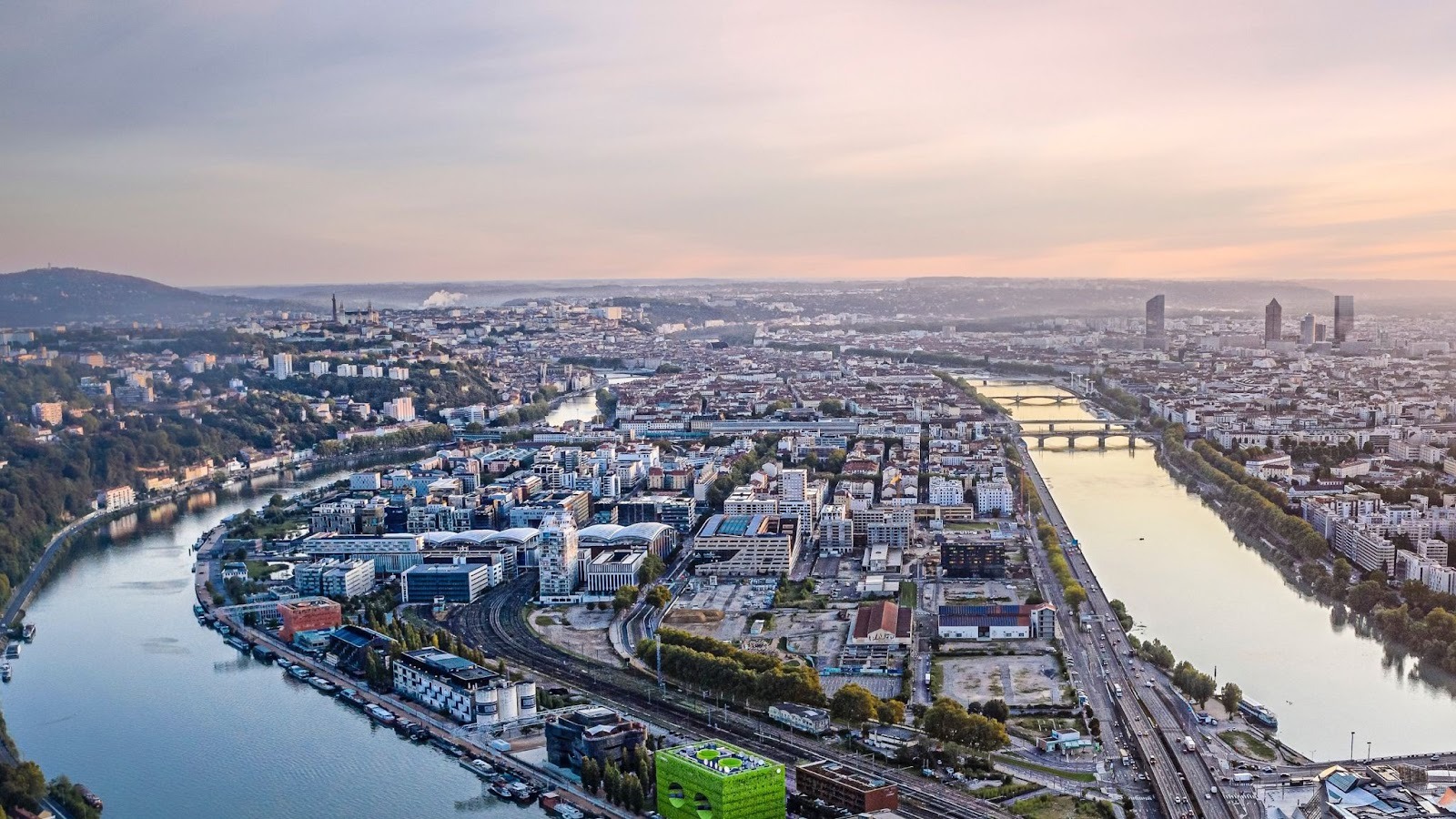
The impact factory model becomes tangible when seen through the four pillars that structure it. Decarbonizing production is the first. Ideally located at the confluence of the Rhône and Saône rivers, the Lyon region can use its waterways to accelerate the decarbonization of its industry.
For instance, the development of river transport on the Mediterranean–Rhône–Saône (MeRS) axis, along with rail transport, provides strategic leverage to meet the challenges of decarbonizing the region and the industries based here.
“In France, transportation accounts for 30% of our greenhouse gas emissions. Decarbonizing the sector requires a shift from road to river and rail,” says Thomas San Marco, chairman of Medlink Ports and a director of Compagnie Nationale du Rhône (CNR).
Circular‑economy practices form the second pillar. Industrial sites that once treated waste as a disposal problem are being encouraged to see it as a resource. A start‑up in the circular economy, perhaps focused on recycling complex plastics or recovering metals from industrial waste, can find a niche in one of the region’s innovation parks. It gains access to pilot facilities, mentoring, and the opportunity to supply local manufacturers seeking to decarbonize their supply chains.
Innovation and R&D make up the third pillar. Lyon’s industrial strategy assumes that cleaner, more efficient processes will emerge through sustained collaboration between companies and laboratories. Competitiveness clusters support joint research projects, pilot lines, and testing facilities. Industrial groups are encouraged to locate their R&D centers in the region, where they can work closely with universities and engineering schools on low‑carbon processes, new materials, and digital tools.
Social and territorial impact is the fourth pillar. Industrial projects are increasingly evaluated on their ability to create local, non‑relocatable jobs, to support small and medium‑sized suppliers, and to maintain constructive relations with nearby residents. The Métropole’s responsible purchasing strategy, which steers some €600 million of annual procurement toward local, low‑carbon, socially positive solutions, is a cornerstone of this approach.
Foucher explains, “These four pillars shape how we welcome new projects, how we support existing companies, and how we use public tools like procurement or planning. If a project cannot show how it fits, it is hard to justify calling it an impact.”
Where The Model Comes To Life
The ecosystem becomes more concrete when seen from the perspective of a company operating in Lyon today. A chemical producer in the Vallée de la Chimie, for example, is likely part of the Pact for Impact, giving it access to shared studies on decarbonization, potential industrial symbioses, and dialogue with public authorities about long‑term infrastructure.
Lyon-based start-up Mecaware has also developed a low-impact battery recycling process using CO₂ to recover key metals such as lithium, nickel, and cobalt from battery waste and production scrap so that they can be reused in new batteries. Co‑founded by researcher Julien Leclaire and incubated by PULSALYS, the company plans to launch a pre‑industrial pilot using Verkor’s production scrap in early 2026.
Additionally, FORVIA, a key global player in automotive equipment, chose Lyon as the birthplace for MATERI’ACT in 2022, pursuing its commitment to materials with low carbon footprints. Through the MATERI’ACT center of excellence in Villeurbanne, FORVIA focuses specifically on designing next‑generation materials with very low carbon footprints, bringing together decision‑making, R&D, and a 2,000‑square‑meter space for start‑ups and small businesses working on sustainability.
Rémi Daudin, president of MATERI’ACT, mentions, “Our plan to establish a site here is consistent with the very foundation of our business, which is to reduce our impact on the environment. We renovated a building rather than constructing a new one, chose a location based on the accessibility of active forms of transport for our employees, and plan to develop collaborations with our industrial and academic ecosystems to act together against climate change.”
People, Talent, And The Common Good
The impact factory model ultimately depends on people as much as on pipes, plants, and policies. According to Foucher, in the Lyon region, the industry is working collaboratively, with educators, professionals, companies, and local authorities to create a productive, local, circular, and inclusive economy.
For instance, engineers, technicians, researchers, and operators will design, implement, and maintain new processes. They benefit from the region’s dense network of higher‑education and research institutions that are increasingly oriented toward ecological, social, and digital transitions.
Students take part in projects with companies and public bodies, often through structures like the Fabrique de l’innovation, where they prototype solutions to real industrial and territorial challenges. Residents and local communities experience the benefits and risks of industrial activity in their daily lives. Lyon’s leaders know that without a strong talent base and social consent, the model cannot hold.
Companies benefit from this pipeline of skills and ideas. They can recruit graduates who understand both the technical and societal dimensions of the transition, and they can tap into research partnerships to keep their innovation efforts grounded in scientific and regulatory developments.
Foucher adds, “Our ecosystem is designed so that those solutions are developed and tested here, with our companies, our universities, and our residents all involved. The goal is to rebuild a relationship between industry and the public based on transparency and shared interests.”
Investment In The Good Of All
ONLYLYON & Co’s work in the Lyon region presents both risks and opportunities. There lies the complexity of coordinating so many actors and expectations, yet a chance to build an ecosystem where companies feel that doing the right thing for climate and society is also the smart thing for business.
The agency believes that if industrial pacts, circular ecoparks, targeted finance, and responsible procurement can keep jobs and know‑how in the region while cutting emissions and improving the quality of life, Lyon’s impact model may offer lessons for other territories facing the same tension between reindustrialization and responsibility.
Nevertheless, the focus is no longer only on producing goods; it is on creating solutions that serve the common good. Instead, the region is treating itself as a laboratory where the impact factory is not a slogan but a daily practice.