

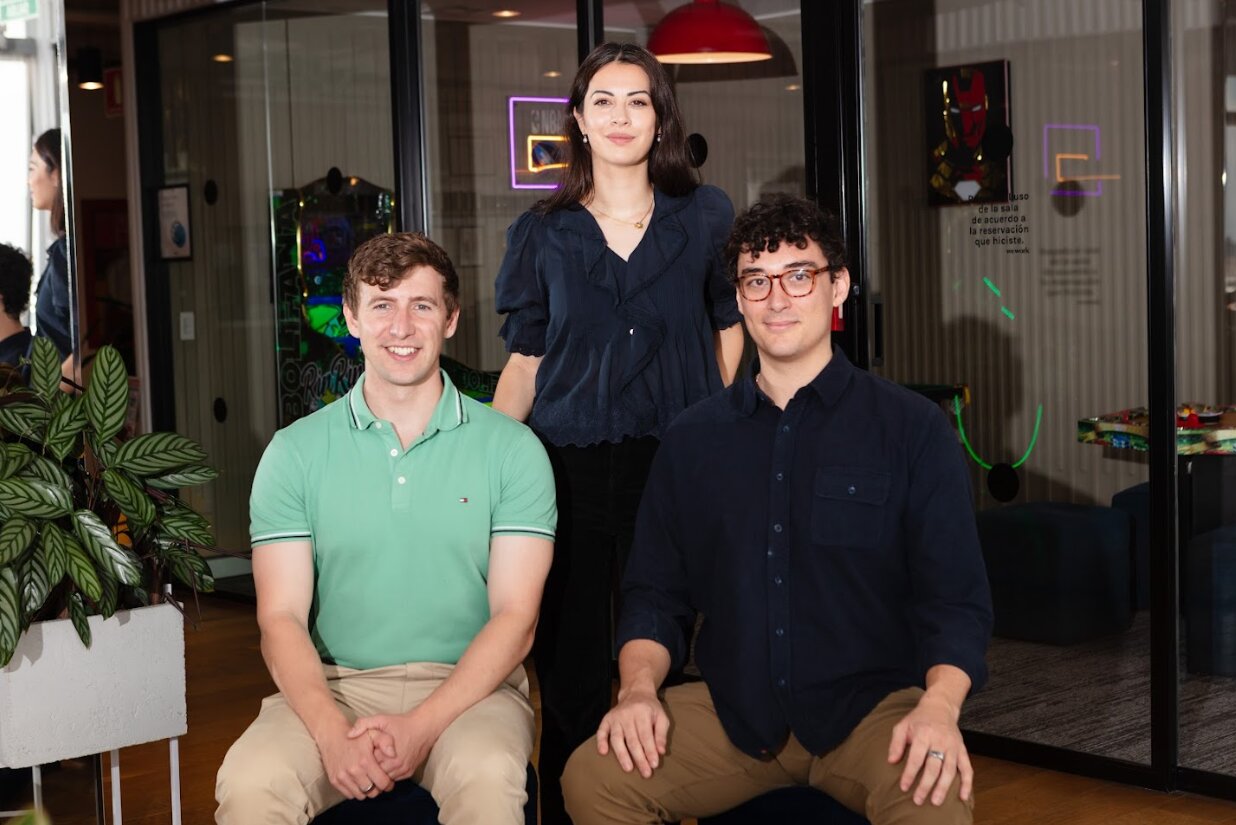
The backpacks lay flat on the Brooklyn grass and served as makeshift goalposts. Lewis Black, Midori Koide, and Jeffrey Estes had managed to gather eleven players for what would become the first GoodRec game in October 2020, during a pandemic that had shuttered gyms, canceled leagues, and left millions of adults craving the athletic communities they once took for granted. The field setup was improvised, the pandemic restrictions were strict, but the hunger for organized play was undeniable. What began as a simple solution to their own problem would eventually connect 700,000 players across more than 68 cities in the United States and Canada.
Black had experienced the coordination nightmare firsthand after graduating from the University of Manchester with a degree in mathematics. Moving to a new city meant starting from scratch. Finding consistent pickup soccer required navigating fragmented Facebook groups, unreliable text chains, and games that either attracted too few players or became overcrowded chaos. The mathematics were frustratingly simple yet seemed impossible to solve. Organizing 22 friends for a proper 11-versus-11 match required Herculean coordination efforts. Schedules conflicted. Commitments wavered. Last-minute cancellations cascaded through group chats. The same story played out across major cities where working adults wanted to play team sports but lacked the infrastructure that once existed through workplace leagues, community centers, and informal neighborhood networks.
The broader sports technology market reached a valuation of $29.74 billion in 2024, with projections suggesting growth to $68.70 billion by 2030, according to data from Fortune Business Insights. Yet beneath these impressive aggregate figures lies a troubling paradox. While professional leagues invest millions in analytics platforms, wearable technology captures 34 percent of market share, and smart stadiums transform fan experiences, recreational participation among working adults continues a decades-long decline. Only 25 percent of American adults currently engage in sports, down from 73 percent who played during their youth, according to research from the Robert Wood Johnson Foundation. The chasm between elite athletic technology and accessible community recreation has widened into a structural divide.
The Architecture O
f Athletic Abandonment
Adult sports participation drops precipitously after college, falling from 40 percent among 18-to-21-year-olds to just 26 percent of adults aged 26 to 49, according to national survey data. The reasons behind this erosion form a complex web of logistical, economic, and social factors. Traditional recreational leagues, which once served as democratic sporting venues, have either disappeared or evolved into expensive travel team systems. Income emerges as a powerful determinant of who continues playing. Adults from households earning under $25,000 annually participate at 15 percent rates, compared with 37 percent participation among those earning $75,000 or more.
Black and Koide witnessed these dynamics destroying the athletic communities they valued. “After college, we were too busy to commit to long-term leagues and struggled to find groups to play with when moving to new cities,” Black recalls. The challenge was not a lack of desire. Working professionals wanted to play soccer, basketball, volleyball, and other team sports. They simply could not overcome the coordination costs that grew exponentially with each additional player required. A tennis match needs two people. A pickup basketball game functions reasonably with six. A proper soccer match demands 22 participants, plus reserves.
The friction accumulated at every step. Someone had to reserve fields or courts, collect payment from participants, purchase equipment, manage attendance lists, and handle inevitable cancellations. These coordination burdens typically fell unevenly on particular individuals who eventually burned out from the thankless administrative work. Text chains devolved into confusion. Facebook groups attracted spam and unreliable commitments. Showing up to public fields meant gambling on whether enough players would appear. The result was predictable. Busy professionals simply abandoned the effort and either switched to individual fitness activities or stopped exercising altogether.
Geographic mobility amplified these challenges. Professionals frequently relocate for career opportunities, severing connections to established athletic communities. Arriving in a new city as an adult meant starting from zero. Schools, universities, and youth leagues provided automatic social infrastructure for finding teammates during earlier life stages. Adults possessed no equivalent mechanism. Making matters worse, the COVID-19 pandemic destroyed whatever fragile coordination systems existed. Leagues canceled seasons. Informal groups dissolved. Facilities closed indefinitely.
Building Infrastructure From Improvisation
The first GoodRec game used backpacks as goals because proper equipment seemed less important than solving the fundamental coordination problem. “We wanted a more flexible and instant way to play sports, so we built the GoodRec app,” Koide explains. That statement belies the complexity of what the platform actually accomplishes. GoodRec functions as a marketplace matching supply and demand across multiple dimensions. Geographic proximity, skill levels, time availability, preferred sports, and facility quality all play a role in the matching algorithm. Users browse upcoming games through a mobile interface, register with advance payment, and arrive at scheduled times to find organized play with balanced teams and provided equipment.
The operational model addresses friction points that plague traditional pickup sports. Games fill with predictable player counts because the platform caps registrations and processes payments in advance. Hosts manage equipment distribution and team balancing, eliminating the need for awkward negotiations on the field. Facility partnerships guarantee field access and maintenance standards. The architecture transforms recreational sports from high-coordination social challenges into low-friction consumption experiences resembling fitness class bookings. Users can play any day of the week across cities ranging from Chicago to Los Angeles, Ottawa to Miami.
Black and Koide initially bootstrapped operations by collecting advance payments from users and channeling those funds directly into field reservations and equipment purchases. Revenue exceeded expenditure, resulting in a positive cash flow from the first game. The model enabled rapid iteration without requiring external capital. Teams of five could play as easily as teams of eleven. Indoor facilities could supplement outdoor fields during the winter months. Basketball and volleyball could expand beyond the initial focus on soccer. Pre-seed funding arrived in 2021, enabling geographic expansion into cities across North America and partnerships with more than 500 facility operators.
The timing proved unexpectedly advantageous despite pandemic circumstances. Isolated individuals craved social connection and outdoor activity. Traditional league infrastructure had collapsed, creating openings for alternative models. Early adopters became evangelists, spreading awareness through organic word-of-mouth rather than paid marketing. “Word of mouth drives our user growth week to week,” Black notes. The company deliberately grew through measured expansion rather than venture-backed blitzscaling, entering markets only after securing facility relationships and identifying potential community leaders who could serve as hosts.
The Economics Of Recreational Infrastructure
Sports technology investment reached unprecedented levels in 2024, with North American markets capturing 38.5 percent of global spending, according to Data Bridge Market Research. The analytics and statistics segment is expected to expand at a 29 percent compound annual growth rate through 2030, driven by demand for data-driven coaching and performance optimization. Smart stadium technology is expected to reach a valuation of $19.8 billion as venues compete to offer immersive experiences that justify higher ticket prices. Yet recreational technology platforms occupy distinctly different market positions.
GoodRec competes less with professional sports technology vendors than with fitness studios, recreational leagues, and informal social coordination mechanisms. The target customer seeks convenient access to organized athletic activity rather than elite performance enhancement. That positioning limits both market size and pricing power compared with enterprise sports technology contracts. The addressable market remains substantial nonetheless. Americans aged 18 to 49 represent approximately 130 million potential customers, of whom only 25 percent currently participate in sports. Capturing even small percentages of latent demand could support significant platform growth.
Facility partnerships constitute a crucial component of the business model. Many operators struggle with utilization rates, particularly during weekday afternoons and evenings outside peak hours. GoodRec guarantees baseline revenue while absorbing marketing and coordination costs that operators would otherwise bear directly. “We work with 350 facility owners in the US, and 500 facility owners in NA to keep their facilities as close to fully utilized as possible,” Black explains. “We use this time to put on awesome experiences for our growing player base.” The arrangement creates aligned incentives between the platform and property owners. Higher participation rates benefit both parties. Quality experiences encourage repeat bookings.
The platform deliberately targets adults who played sports during their youth but stopped after college. Product design assumes a baseline level of athletic competence and nostalgic affection for team sports, rather than introducing novices to unfamiliar activities. Games accommodate a range of abilities while maintaining a competitive intensity suitable for recreational contexts. Hosts balance teams to ensure competitive matches rather than teaching fundamental skills. The experience recreates college intramurals rather than youth development leagues. Some hosts have become local celebrities, whose scheduled games fill weeks in advance, because players trust the quality of the experience.
Community Formation Through Digital Coordination
Youth sports participation data expose troubling long-term trends for the recreational sports sector. Regular participation among boys aged 6 to 17 declined from 50 percent in 2013 to 41 percent in 2023, according to data from the Sports & Fitness Industry Association analyzed by the Aspen Institute’s Project Play. Girls’ participation rates increased over the same period, but primarily through expensive travel team models rather than accessible community leagues. Children from households earning under $25,000 annually saw participation rates drop to 25 percent, compared with 39 percent among families earning over $100,000 per year.
Those childhood participation patterns predict future adult behavior. Adults who never developed sporting habits during youth rarely adopt them later. The current generation of children playing sports at historically low rates will become the next generation of adults with diminished athletic engagement. Without intervention, recreational participation could continue its secular decline even as technology platforms proliferate. GoodRec aims to reverse this trajectory by reducing the coordination costs that deter working adults from participating in team sports.
Black emphasizes social outcomes over mere transactional efficiency. “Our hope is that GoodRec brings people together,” they reflect in company materials. “We love hearing that best friends have met, relationships have started, and group chats have been born through our soccer games.” The platform actively encourages relationship formation through features like player profiles, regular scheduling at consistent venues, and host continuity. Users who attend the same weekly game develop familiarity and social bonds extending beyond the field.
Geographic expansion follows patterns shaped by urban density, facility infrastructure, and local sports cultures. Cities with populations exceeding 500,000 offer sufficient user bases to sustain regular games across multiple sports and locations. Soccer dominated early participation, reflecting both founders’ backgrounds and the sport’s accessibility requirements. Basketball followed as the platform expanded beyond outdoor fields into indoor facilities. Volleyball emerged as an unexpected success, particularly among female participants seeking less physically aggressive team sport options. Each sport required distinct operational approaches regarding facility types, equipment needs, team sizes, and scheduling patterns.
Weather variability posed persistent challenges for outdoor sports in northern climates. Winter months decimated participation in cities lacking affordable indoor alternatives. GoodRec responded by developing partnerships with indoor sports complexes willing to offer discounted rates during slow periods. The strategy created year-round revenue streams for facility operators while maintaining user engagement through seasonal transitions. Canadian cities demonstrated participation patterns similar to those in American markets, although cultural differences in sports preferences necessitated product adaptations.
The platform faces inherent tensions between commercialization and community formation. Technology can reduce coordination costs and guarantee baseline quality standards. Whether digital platforms can genuinely foster authentic community rather than merely facilitating efficient coordination remains an empirical question. Critics argue that introducing monetary transactions and centralized coordination potentially commodifies social interactions that previously occurred through voluntary cooperation. Self-organized pickup games foster stronger community bonds when participants negotiate rules collectively and develop shared norms organically.
Black acknowledges these concerns while pointing to practical realities. “Traditional pickup games work wonderfully when they work,” he concedes. “But they don’t work for most people in most situations anymore.” Working adults in major cities confront long commutes, irregular schedules, unfamiliar neighborhoods, and limited free time. Waiting at public courts hoping enough players appear becomes prohibitively inefficient. Organizing games through text chains requires someone willing to assume coordination burdens that often fall inequitably on particular individuals. The platform represents an experiment in whether marketplace design can partially substitute for eroded community institutions.
Looking toward 2030, demographic and technological forces will reshape recreational sports landscapes in ways that favor platform-mediated experiences. Remote work arrangements will disperse professionals geographically while increasing schedule flexibility. Virtual reality fitness experiences will compete directly with in-person recreational sports for leisure time. Climate change will disrupt outdoor sports seasons in unpredictable ways. Aging populations will demand different recreational formats than traditional competitive team sports. Whether GoodRec’s model proves sustainable depends on factors extending beyond any single company’s control.
Income inequality, urban design, work culture, and cultural attitudes toward adult play all shape recreational sports participation in ways that technology platforms can influence but cannot determine alone. The sports technology market is expected to exceed $68 billion by 2030; however, adult participation in actual sports may continue to decline without deliberate intervention. Capital flows abundantly toward professional sports analytics while recreational infrastructure languishes. The challenge facing GoodRec and similar platforms involves not just building better coordination tools but reconstructing social infrastructure that once made recreational sports accessible through workplace leagues, community centers, and informal neighborhood networks.
The company has demonstrated that reducing organizational friction expands participation among latent demand. Games that once required 22 friends to coordinate now require zero. Users simply open an app, select a game, and show up. Equipment appears. Teams get balanced. Play commences on schedule. That simplification represents genuine progress in addressing the coordination failures that drove millions away from team sports. Whether the progress proves sufficient to reverse decades-long declines in participation will unfold gradually as the platform matures and competitors emerge with alternative models.
“We want to make playing team sports as easy as going to the gym,” Black reflects. The analogy reveals both ambition and limitation. Gyms succeeded by reducing friction around individual fitness activities. Franchises proliferated by offering convenient locations, flexible hours, and standardized equipment without requiring advance coordination with other participants. GoodRec attempts to achieve analogous friction reduction for team sports, but the inherent coordination requirements impose structural constraints that individual fitness activities typically avoid. The experiment continues across dozens of cities where the backpacks have been replaced by proper goals, but the fundamental challenge remains unchanged. How do you help adults maintain athletic communities amid the dispersing forces of modern urban life?