

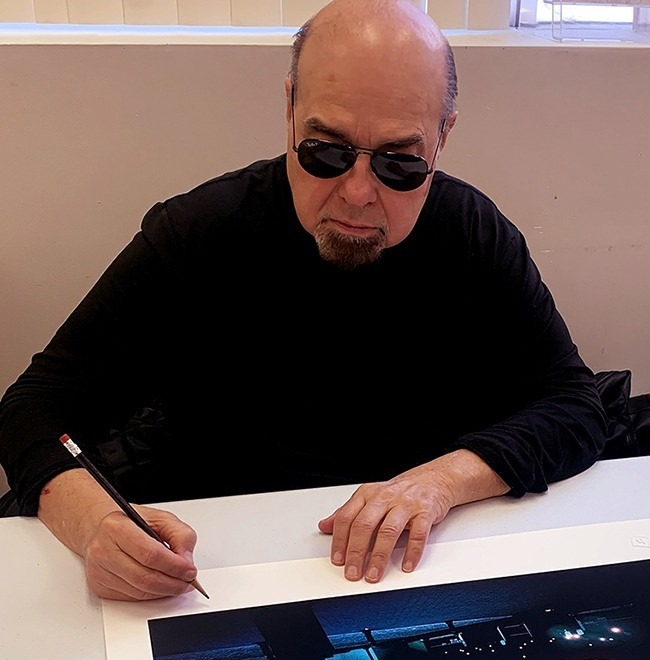
In 1983, a college student from Athens, Greece, handed in his first professional album cover. Four decades and more than 350 covers later, Ioannis Vasilopoulos had become one of the most prolific rock artists of his generation. He died in April 2025 at the age of 66, and the genre he spent his life illustrating lost one of its most distinctive visual voices.
The tributes that followed his passing reflected the breadth of his reach. From progressive metal bands to arena rock giants, the artists who worked with Ioannis spanned nearly every corner of the genre. Voivod, one of his longtime collaborators, described the loss as that of an artist “whose work resonated deeply within the rock and metal community.” For fans, the reaction was more personal. His covers were the first thing they saw before they ever heard the music.
From Athens To The Record Bins
Born in Greece and raised in the United States after his family immigrated in 1967, Ioannis grew up at the precise moment when album cover art was operating at its most ambitious. Roger Dean was building alien worlds for Yes. Hipgnosis was placing inflatable pigs over Battersea Power Station for Pink Floyd. These were not illustrations. They were statements, and Ioannis studied them with the focus of someone who had already decided what he wanted to do with his life.
His first professional cover, painted for Art in America on Sony Records in 1983, was later included in Michael Ochs’s book 1000 Record Covers, among the standout covers of the 1980s. That kind of recognition, earned before his career had fully started, confirmed the direction he was already moving in. By 1985, he had joined Lieber and Krebs, the management firm behind Aerosmith, AC/DC, and the Scorpions, and had designed logos and tour materials for some of the biggest rock acts.
What those early years established was not just a career but a working method. Ioannis approached each project as a visual extension of the music itself, studying the band’s sound and identity before committing anything to canvas. That process, slow and deliberate became the foundation of everything that followed.
The Paintings That Stuck
The 1986 cover for Fates Warning’s Awaken the Guardian is the piece that most often comes up when fans and critics discuss his legacy. A surreal, densely detailed painting, it locked in the visual tone of progressive metal for an entire era. Metal Blade Records later reissued the album as a collector’s vinyl, with the artwork positioned as the centerpiece of the release.
Other defining works followed across the next three decades. His cover for the Allman Brothers Band’s “Where It All Begins” in 1994 survived a label objection when the band stepped in and insisted on it. The painting now hangs in The Allman Brothers Band Museum in Macon, Georgia. In 1995, Bon Jovi brought him on as Creative Director for their world tour, a role that extended his work beyond individual album sleeves into the full visual machinery of a global concert campaign.
Deep Purple, Styx, Blue Öyster Cult, Uriah Heep, King Crimson, Lynyrd Skynyrd, and Dream Theater are among the dozens of artists whose records carry his signature style. Each commission followed the same principle. The painting had to earn its place alongside the music, not simply accompany it. Across a 40-year career, that standard held.
Painting By Hand When No One Else Did
By the time the music industry had fully migrated to digital design software, Ioannis had become something of an anomaly. He continued to paint by hand, using brushes and physical pigment to produce canvases that collectors could immediately distinguish from computer-generated work. That distinction mattered in ways that went beyond aesthetics. His limited-edition signed prints sold out regularly, and his original paintings entered private collections and museums across the world.
The broader vinyl market reinforced the value of that approach. The global vinyl record market reached USD 1.9 billion in 2024 and is projected to grow at 9.3% annually through 2029, driven significantly by younger buyers returning to physical formats. For that audience, cover art is a primary part of the appeal, and the artists who produced enduring hand-painted work are seeing renewed collector demand as a result.
Among his final projects was a collaboration with photographer Mick Rock, who provided a previously unreleased photograph of Freddie Mercury for Ioannis to hand-paint over, producing a limited-edition fine art print timed to Mercury’s 75th birthday. It became one of the last official projects Mick Rock completed before his own passing. The Rock estate has since granted permission for additional works in the series, with future pieces planned around Keith Richards and Jerry Garcia.
The Last Chapter
Separately, Ioannis had finalized a partnership with Deko Entertainment and ADA/Warner Music Group on two collector bundles tied to the forthcoming Led Zeppelin documentary. The 1979 Knebworth Bundle and the 1971 Hermit Bundle each pair a Warner archive vinyl record with a signed and numbered print from his Get the Led Out collection and a branded T-shirt, limited to 300 sets each. The bundles represent one of his last completed commercial endeavors, and demand among Led Zeppelin fans has been immediate.
His estate continues operating through Dangerous Age, the platform he established in 2010 to bring his work directly to collectors and fans. The prints, books, and bundles remain available. The covers, pressed into millions of sleeves across four decades of rock history, were already long in place before he put down his brush for the last time.