

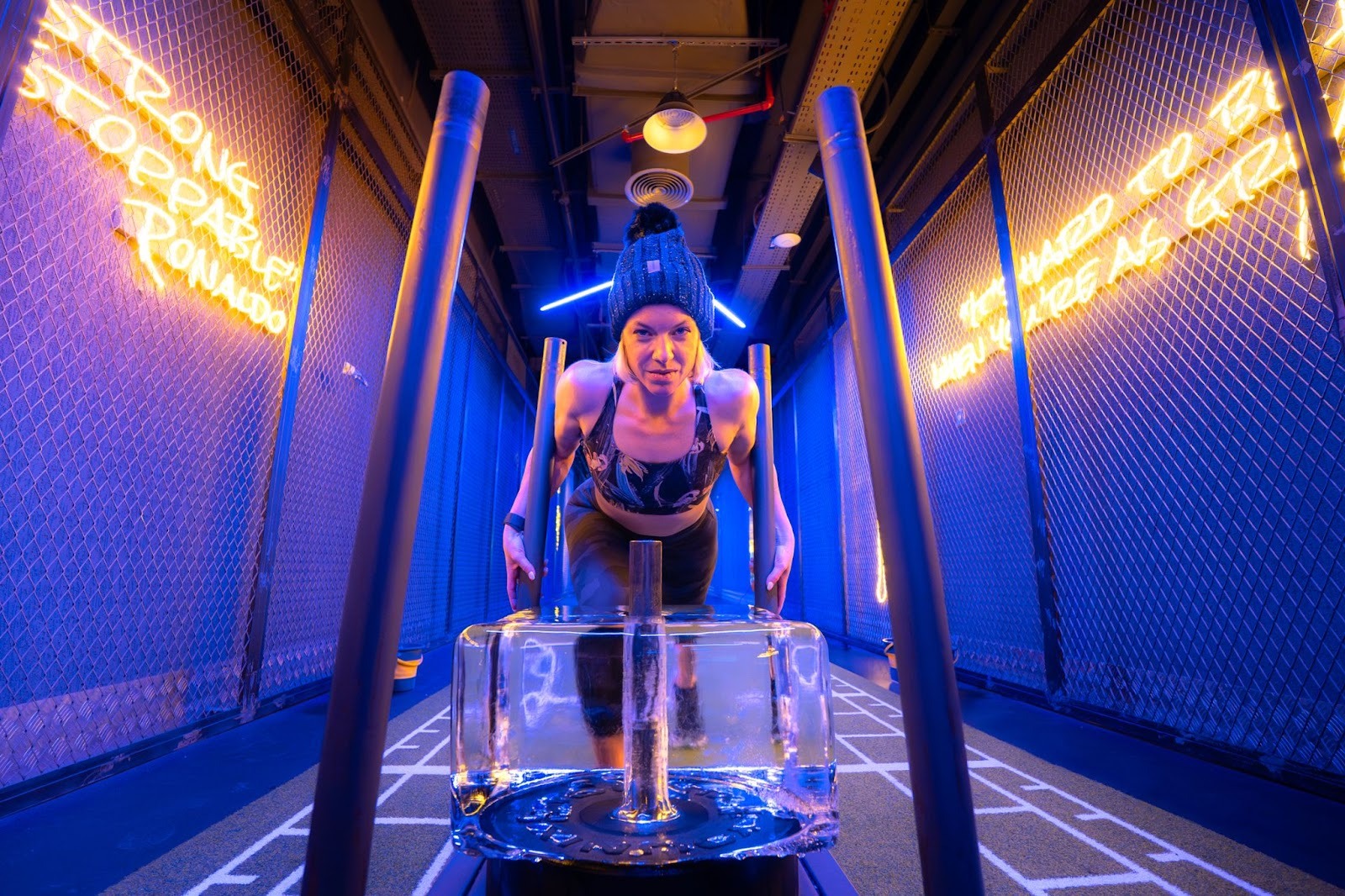
With July and August temperatures in Dubai averaging 43°C (109°F) and humidity surpassing 70%, outdoor workouts in the Gulf can quickly become dangerous. GymNation’s latest experiment, “The Coolest Class in Dubai,” offers an indoor, climate-controlled alternative that integrates cold exposure directly into high-intensity training.
The sessions combine treadmill sprints against industrial fans, squats with ice-weighted vests, sled pushes with ice blocks, and post-workout immersion in ice baths. Gloves and headgear are provided to manage comfort during the sub-zero elements of the routine, while chilled towels help regulate body temperature mid-session.
According to sports science research, training in colder environments increases cardiac output and oxygen utilisation, potentially boosting endurance and calorie burn. Aderito Manuel, a sports scientist, notes that such workouts can trigger brown adipose tissue activation, increasing daily calorie expenditure by about 300 kcal.
A Measured Response To Seasonal Demand
GymNation says the concept arose from member feedback during peak summer, when traditional training spaces become overcrowded and outdoor exercise is impractical. “When the summer heat hits its peak in July and August, finding ways to stay active without overheating becomes a real challenge,” says Rory McEntee, the company’s Chief Marketing Officer. “With ‘The Coolest Class in Dubai,’ we’re turning that challenge into an opportunity.”
The decision to launch the programme was backed by a 23% year-on-year increase in online searches for “cool classes” in Dubai. The data suggested both a practical need and a market appetite for novel, temperature-adapted workouts.
Sessions are scheduled on four consecutive Saturdays in July and are open to both members and non-members. This limited run allows GymNation to measure participation, collect feedback, and assess whether the format should become a recurring seasonal feature.
The Physiology Behind Cold-Condition Training
Cold-environment exercise has been studied for its ability to stress the cardiovascular system in ways different from heat-based or temperate training. When the body is exposed to cold, it works harder to maintain core temperature, often resulting in higher oxygen volumes in the blood—up to 11% more, according to cited research.
Beyond cardiovascular effects, training in cold conditions has been linked to improvements in mental resilience. Lower perceived exertion after adaptation and up to 17% increases in pain tolerance have been recorded in controlled trials. These physiological factors are part of why elite athletes often use cold immersion or snow-based training to complement their regimes.
McEntee says GymNation’s goal was to bring some of those benefits into a mainstream, accessible class format. “It’s about delivering a workout that challenges both body and mind, but in an environment where participants feel safe and supported,” he explains.
From Market Trend To On-the-Ground Experience
The Gulf’s fitness market is experiencing steady growth, with the UAE’s health and fitness club sector valued at roughly USD 484 million in 2024 and projected to expand over the coming years. Saudi Arabia’s market, now over USD 1 billion, is also on an upward trajectory, driven by policy initiatives encouraging physical activity.
Within this environment, operators are experimenting with formats that combine novelty with measurable health outcomes. Climate-adapted training fits into this niche, offering a draw for those seeking more than conventional gym routines.
The Coolest Class is structured as a group high-intensity interval training (HIIT) session, but its novelty comes from integrating physical stressors not typically found in indoor settings. Ice bucket carries challenge grip strength, while resistance from fan-generated wind on treadmills tests both speed and stability.
Looking Beyond The Pilot
The launch aligns with GymNation’s broader expansion strategy across the GCC, where climate extremes and changing consumer expectations intersect. Although the company has not confirmed whether the class will roll out to other cities, McEntee suggests the pilot is more than a seasonal marketing exercise. “If the data shows people are not only enjoying it but seeing measurable results, then there’s no reason it can’t be adapted for other locations,” he says.
For now, the Coolest Class offers a case study in adapting global fitness trends to local conditions. It demonstrates that in regions where heat limits physical activity, climate-controlled training may move from novelty to necessity—especially as summer temperatures and humidity continue to push historical limits.