

In the windowless conference rooms of high‑growth startups, a quiet humiliation repeats itself daily. The people entrusted with millions of dollars and dozens of jobs are often found scrolling three inboxes and seven chat apps, hunting for a single critical message. The crisis is not a shortage of information but a collapse in knowing where attention should go next.
That problem has sharpened in the past two years. By 2025, global email traffic had climbed past roughly 370 billion messages a day and continues to rise. Business messaging—spanning SMS and app‑based channels—is projected to grow from about two trillion messages in 2025 to nearly three trillion by 2030, driven by conversational commerce and support. The digital world is not just noisy; triage itself is becoming a full‑time job.
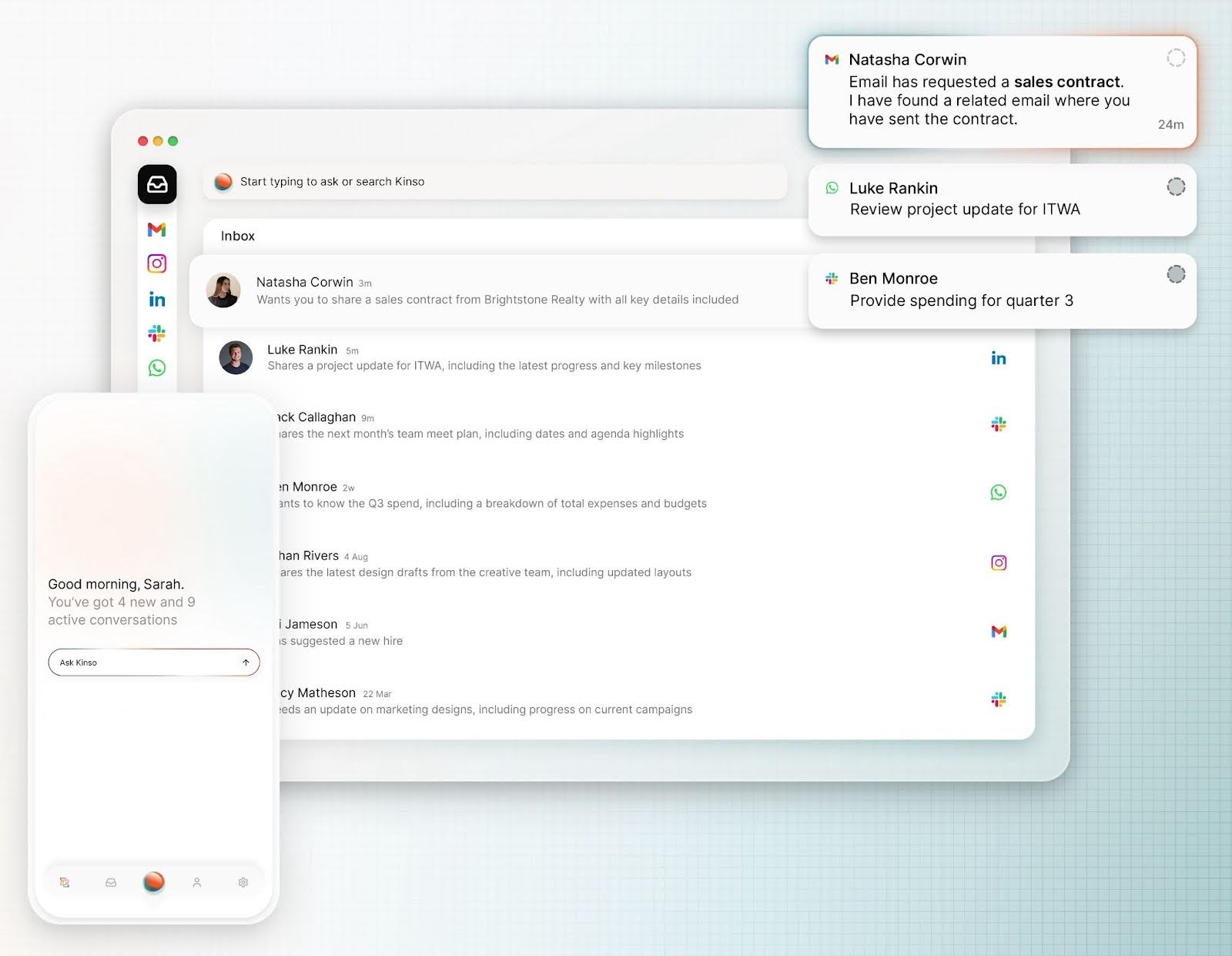
Into that environment stepped Kinso, an Australian startup founded by brothers Frank and Jacques Greeff after a previous nine‑figure exit in real‑estate technology. Their new company offers a universal inbox, a single interface that ingests email, Slack, WhatsApp, LinkedIn, Instagram, and more, then uses artificial intelligence to decide what a time‑starved operator should see first. The idea is not to add more notifications but to turn attention, and the actions that follow, into something measurable and deliberate.
The Hidden Cost Of The Notification Boom
The modern notification stack arrived by accretion. Email colonized workdays decades ago, but the rise of always‑on chat, social messaging, and collaboration tools completed the inversion: workers no longer check messages, their messages check them. Analysts estimate that hundreds of billions of emails now move daily, while SMS and app‑based messages boast open rates near 98 percent and are typically read within minutes. The numbers delight marketers and platforms, but they brutalize human concentration.
Forecasts suggest that by 2030, business messaging traffic alone will approach three trillion messages a year, up sharply from mid‑2020s levels. The growth is fueled less by one‑way alerts than by multi‑day conversational threads that cut across teams and tools. The result looks less like a mailbox and more like an unstructured, high‑stakes database with no schema and no reliable index. Decision‑makers spend large portions of their week not making decisions but searching for the information that would let them make one.
The Greeff brothers saw this dynamic up close in their previous venture. Deals stalled because crucial messages were buried in Slack or email. Introductions were never made because a name in one thread never intersected with a request in another. They left with capital and credibility but also with the conviction that their next company should attack the attention problem itself. Kinso is their attempt to formalize the ad‑hoc triage rituals practiced by experienced operators.
Kinso ingests messages from multiple channels into a single view and ranks them according to impact, using models tuned to founders’ key performance indicators such as fundraising, hiring, revenue, and strategic relationships. Instead of presenting a chronological firehose, the system constructs what it calls an “opportunity stack”—a reordered list meant to reflect where scarce attention is most valuable. The promise is less “inbox zero” than “inbox in order of consequence.”
One Inbox, Many Channels, No Context Lost
Universal inbox tools are not new. Shared inboxes and unified communication suites have promised consolidated views for years. What distinguishes this effort is the insistence that putting channels side by side is not enough. Kinso’s value proposition depends on recognizing patterns across them: who is talking about what, where, and how conversations relate to revenue, talent, or risk.
To do that, the system uses schema‑less ingestion and graph‑based mapping. In practical terms, it accepts messages from email, chat, social DMs, and collaboration tools, then searches for semantic and relational links. A WhatsApp question about contract terms is tied to the original email discussing those terms, which may also connect to a fundraising update referencing the same customer or investor. When an operator opens a thread, the context no longer ends at the borders of one app.
On top of this sits what the company describes as “second‑brain memory.” Users can issue plain‑English queries, asking for all recent exchanges about a Series A round with a particular person, and receive a synthesized view drawn from multiple channels. Before a meeting, the system can surface a briefing that includes previous commitments, open questions, and personal details that might otherwise be forgotten. The aim is to replace nagging uncertainty with a structured, machine‑assisted recall of what has already been said.
Privacy concerns shape how that assistance is delivered. Kinso emphasizes encryption and granular permissions and avoids sending user conversations to train external models. In an era when executives are wary of yet another vendor sitting in the middle of their deal flow, those choices are as strategic as they are technical. To function, the product needs access to highly sensitive communications; to gain that access, it must convince operators that it will not misuse their data.
Within those constraints, Kinso aspires to behave less like a static dashboard and more like an anticipatory assistant. The software does not only remember; it infers what might need to happen next. The distinction signals a shift in workplace AI. Instead of focusing on generating new text or images, a growing class of tools is trying to interpret existing conversations and nudge human users toward timely, context‑aware action.
From Conversations To Actions In Real Time
Kinso’s more assertive features reflect that ambition. The platform does not simply rank threads; it attempts to convert them into immediate options. When the system detects a clear request—a search for a senior engineer, a question about expansion into a new market, a hint that a customer may be at risk of churn—it tries to match that need with people in the user’s network who might help. It then suggests a warm introduction and drafts a message in the user’s voice, ready to be edited or approved.
The goal is to compress the distance between information and action. In a world where business messaging volume could reach the trillions annually by 2030, the advantage may go not to the organization receiving the most signals, but to the one acting fastest with the richest context. Pre‑drafted responses and recommended introductions are meant to make “fast and thoughtful” less of a contradiction, especially for leaders whose value lies in judgment rather than typing.
Industry data leave room for this kind of reinterpretation. Email remains central to business life, yet substantial portions of outreach never reach the primary inbox or are ignored for lack of trust and relevance. SMS and messaging apps excel at immediacy but risk exhausting recipients with volume, prompting many users to cite over‑messaging as a major irritation. The status quo is an arms race in which every channel is densely instrumented but poorly interpreted.
Kinso positions itself as a step away from that dynamic: fewer prompts, more meaning. The company has cultivated a following by “building in public,” broadcasting product decisions, failures, and iteration in real time through social channels. That transparency has attracted a wait list heavy with founders, investors, and chiefs of staff who view the inbox problem as a strategic liability rather than a minor annoyance. For them, the question is not whether to adopt AI, but where in the stack it should live.
Yet the field is crowded. Established email clients, customer‑relationship systems, and help‑desk platforms are all adding AI‑assisted triage and unified views of customer conversations. Some already offer automation that suggests next steps for sales or support teams. Kinso’s bet is that a channel‑agnostic, network‑aware architecture—one that treats every message as a potential node in an opportunity graph—will prove harder to copy than a chatbot interface or a smarter filter.
Kinso effectively sits between the raw feed of notifications and the people responsible for making sense of them. Its success will depend on execution and trust, but also on whether its central promise—that attention can be made truly actionable—matches the experience of those who adopt it. The communications stack is unlikely to get quieter between now and the end of the decade. If the right people still see the right things in time to act, it may be because systems like this learned how to turn a wall of alerts into a ranked list of decisions. In a decade defined by abundance of messages and scarcity of focus, that would be a subtle but consequential shift.