

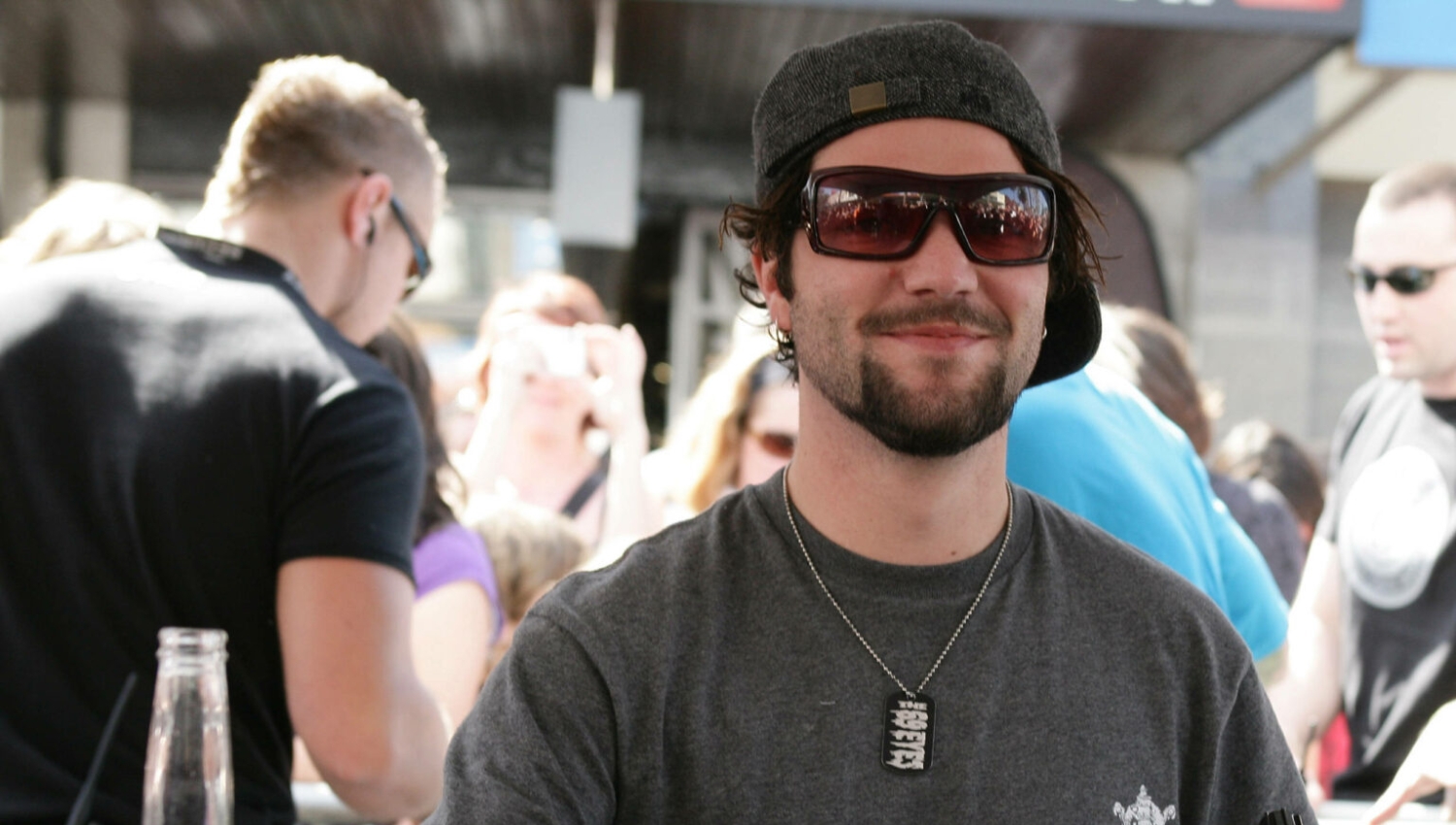
Jackass star Brandon “Bam” Margera had been on the phone barely ten minutes when a fan spotted him in a Seattle parking lot and asked for a photo. “Dude, I pulled up and thought, ‘That can’t be Bam,'” the man said. Margera posed, his broad grin flashing several silver crowns, his broken thumb in a metal splint from a recent skateboarding fall, then climbed back into his car. Even now, the daredevil pulls the kind of fame few ever reach. “I can’t walk a hundred meters down the street without taking twenty pictures,” said Margera, 46, with the mischievous grin that made him famous more than two decades ago.
Margera turns up in what is billed as the final Jackass film, Jackass: Best and Last, but he is barely in it. The movie doubles as a farewell to the franchise and a reminder of how years of addiction, feuds and legal fights pushed him, once a supporting player across the first three films, to the margins.
His appearance is mostly archive footage, including the “bull teeter-totter,” in which he was one of four people on a seesaw in a bull pen dodging the animal’s horns, and the “high five,” in which a giant spring-loaded hand smacked him to the ground. There is also a previously filmed scene of him trying to escape a room with a loose rattlesnake, shot in 2020. He recorded nothing new for the film.
Although he has since found love again, which he credits along with a run of psychedelic experiences and purging rituals for keeping him sober, he skipped the premiere. The bitterness of his firing from the previous film, Jackass Forever, still cuts too deep.
“I’ll definitely watch the movie and hope it’s good, but as far as a reunion goes, that’s not going to happen, not in ten million years,” says Margera, who now sports face tattoos, four nose rings and a trimmed goatee. “I don’t have any hard feelings toward the cast of Jackass. It’s the decisions Johnny Knoxville and [director] Jeff Tremaine made. I never want to see either of them again in my life.”
The roots of the fallout
The rift traces back to 2019, before filming began on the fourth movie. Margera signed a wellness agreement with the producers committing him to sobriety as he battled alcohol addiction. According to a later lawsuit, that meant breathalyzer tests three times a day, urine tests twice a week and regular hair follicle analysis. “I knew from the beginning they wanted to sabotage me,” he says.
That August he was removed from a plane for allegedly being too drunk. Yet at times he seemed set on recovery, even appearing on The Dr. Phil Show to insist he was sober aside from prescribed Adderall for ADHD. “I never drank until I was about 22,” he told the host, describing the impossible demands of the stunts. “You’re on a roof with a shopping cart, and there’s a bush. You can’t do that clean… So give me some tequila shots.”
Fired from Jackass Forever
A few months into filming Jackass Forever in mid-2020, things unraveled. “They put me up in a dodgy hotel, with a guy outside the door to make sure I didn’t go out and get alcohol,” Margera says. “I was on set once, and they just said, ‘Piss in this cup.'”
In August 2020, Paramount fired him after accusing him of taking non-prescription amphetamines, which he denied. “To tell someone that after all that, believing he was going to get five million dollars, he’s not in the movie and he’s not getting any money… I was fucking furious,” he says.
His anger boiled over into a call for fans to boycott the film, a lawsuit against Paramount, Knoxville, Tremaine and others alleging “inhumane” and “discriminatory” treatment, and efforts to block the release. Alleged threats against Tremaine led the director to obtain a restraining order. Margera said he had been diagnosed with bipolar disorder months earlier.
In their response, Paramount’s lawyers wrote that they had tried to “help Margera by attempting to include him in the film on the condition that he remain sober and take steps to save his own life,” but that within months he stopped his required alcohol tests, cut off his treatment team, evaded a drug test and relapsed. The case was later settled out of court, and Paramount declined to comment.
Co-star Steven “Steve-O” Glover wrote on Instagram at the time that everyone had worked hard to get Margera into the movie and that all he had to do was stay sober. In a recent interview, Knoxville said he understood why Margera felt let down but stood by the line the producers drew, adding that he would love to have Margera back in his life if he stays healthy.
The conservatorship
After Jackass Forever, Margera’s life fell under a controversial conservatorship for two years, arranged, he says, against his will by a woman who had developed a virtual reality and biofeedback addiction program. That made him, in his words, “the Britney Spears of Jackass.” The saga featured in an episode of an HBO Max documentary series last year.
“A woman named Lima [Jevremovic] tricked my parents into sending her $150,000, which essentially gave her the means to have me locked up,” he says. “That was a really dark time, and I never want to hear her name again.” Jevremovic sued him for defamation in December, but a judge dismissed the case over jurisdiction. Her company did not respond to requests for comment. Margera ultimately spent two and a half years in a rehab facility tied to the so-called “Florida Shuffle,” a system in which certain centers allegedly keep insured patients cycling endlessly through programs.
Eighteen pills and no way out
“I was in 13 different treatment centers, 90 days each, one after the other, and they prescribed me 18 different pills,” Margera says, describing weight gain, stiff muscles, hair loss and worse. He put the total billed to his health insurance at a “funny number” of $666,000. “I felt completely hopeless and defeated.” At the same time his savings dwindled to almost nothing amid a custody battle with his then-wife Nikki Boyd and the Paramount lawsuit.
The strain nearly killed him in December 2022. “I had practically five seizures of twenty minutes each,” he recalls. “Eight days later, I woke up on a ventilator, with a tube in my throat, suffering from Covid and pneumonia. That was my absolute lowest point.” For the first time in his life, he prayed.
Before it all: CKY and the birth of a format
To understand how Margera reached that hospital bed, you have to go back to the beginning. Long before YouTube, TikTok and Mr. Beast, grainy VHS tapes circulated of an anarchic teenager from West Chester, Pennsylvania, skateboarding on freight trains, wrecking rental cars and pranking his father Phil.
Back then no one called it content. Margera simply made skate videos laced with funny moments, and that, along with his CKY (Camp Kill Yourself) crew, was groundbreaking. The fast-paced formula, built on recurring characters led by a charismatic figurehead, escalating stunts and the sense of watching real friends, became a blueprint countless internet creators would later follow.
CKY laid the foundation for Jackass, which exploded on MTV in 2000 and turned the skateboarding troublemaker into one of the few skaters to ever become a genuine brand. Jackass: The Movie led to his own show, Viva La Bam, which ran from 2003 to 2005. Across five seasons he toured the world with his antics, turning his childhood home into a skatepark along the way.
At his peak, Margera appeared in the Tony Hawk’s Pro Skater games, starred in commercials and lived a jet-set life unimaginable for someone who dropped out of school on the first day of tenth grade. Jackass Number Two arrived in 2006. During filming he spent a night in jail after, he says, being arrested drunk with brass knuckles at LAX and charged with a felony. His co-stars, he claims, “high-fived me for the publicity.”
The imperial era and the first crash
The run-up to his first marriage became the 2007 MTV series Bam’s Unholy Union, with Iggy Pop appearing at the Philadelphia wedding party before a Dubai honeymoon. Sipping champagne on camera in a penthouse suite, the unlikely countercultural icon was at his height.
But the fame that made him rich slowly pulled him apart. He woke one day feeling he had nothing left to achieve. “I was standing in my driveway staring at a purple Lamborghini, a blue Lamborghini, a red Ferrari… and I thought: I have no more desires or goals, I have nothing left to prove to anyone,” he recalls.
Ryan Dunn’s death and ten years off the board
Despite the box office success of Jackass 3D in 2010, his spiral deepened when his best friend and co-star Ryan Dunn died in a car crash the following year. “I started drinking to forget,” he says. “I literally didn’t touch a skateboard for ten years.” He described waking up, vomiting bile and cracking open a beer to cure the hangover, all day long. “It was so bad I thought I couldn’t stop.”
In that stretch he hosted a season of Bam’s Bad Ass Game Show on TBS, toured as a singer with his band, and kept moving in celebrity circles. His son Phoenix was born in 2017. “Phoenix made me fight for myself and save my own life because I have to be there for him,” he says.
Psychedelics and a fresh start
Conventional detox was not the only path he tried. In December 2020, as the film dispute escalated, he undertook a series of psychedelic journeys he sees as central to his recovery, even though he relapsed afterward. He completed seven ceremonies in Escondido with a man he calls “the shaman-sorcerer,” taking psilocybin mushrooms and harmala. “You think about the web of events that led to my breakdown… and then you kind of figure out who you really are. It helped me tremendously,” he says.
He also tried Kambo, a toxic frog secretion known for its purging effects. “Your face swells up like a big red football, and you vomit up every tar and poison known to mankind,” he says.
Then, months after surviving seizures, pneumonia and Covid, Margera wandered to the pool bar of the Sunset Marquis in Los Angeles and, by then divorced from Boyd, overheard a woman in June 2023 who caught his attention. “I suddenly hear this girl, ‘Listen, I’m 43, Sicilian and Irish, and I was born in Jersey.’ And I’m like, ‘I’m 43, Sicilian and Irish. I was born in Philly’… And I see the hottest woman ever, and I’m like, ‘I need to talk to her.'”
Dannii Marie, a stretching coach, hit it off with him immediately and soon invited him for a walk. “I asked, ‘What kind of dog do you have?’ She said, ‘A brown pit bull.’ And I said, ‘Thank you, God.'” He proposed that October, and they married in May 2024. In his vows, Margera credited her as central to his sobriety and to regaining his old level on the board through her stretching program.
Sober, married and back on the board
He was at a restaurant in Ocala, Florida, with Dannii Marie when the documentary about him premiered last year. “I said, ‘What the hell, I never authorized this, turn it up!'” he recalls, adding that it made clear how wrong the conservatorship arrangement had been.
Now the man who built a career on chaos is attempting something harder than any stunt: learning how to be happy without alcohol, drugs and drama. “It wasn’t easy,” he says, “but I know that boredom is my trigger.” Whenever he was bored, he would spot an Irish pub across the street and think it looked like fun.
With drinking off the table, he fills the empty moments with skating, just as he did before fame made Pennsylvania skateparks impossible to visit unnoticed. He is currently filming a documentary series for Red Bull’s Skate Tales franchise, chronicling his return to top-level skating. “Skateboarding is my therapy, my mind, my medicine,” he says. “The pounds are gone, the muscle memory is back, and at 46, I’m actually learning and inventing new tricks. All I want to do now is skateboard.”