

Before the change in leadership, Saturday nights at the Kennedy Center hummed with activity. Ten or twelve shows a day were routine, all nine venues on campus running full, drawing more than 7,500 people into the halls.
This past Memorial Day weekend felt like a different world. Standing alone in the Grand Foyer after a shift at the box office, a job held there since September 2019, the silence was impossible to ignore. The only performance that evening, “Shear Madness,” was staged upstairs in the Theater Lab for an audience made up largely of a school group. Everything else that had once filled the calendar for that date had been canceled long before.
The past sixteen months have been brutal for the staff. On most nights the sheer beauty of the building can offer some distraction, but the emptiness that evening only underscored what has happened. A single spoken word would have echoed across the space, off the Orrefors crystal chandeliers and sconces donated by Sweden, the Belgian mirrors, and the eight-foot bronze bust of President John F. Kennedy by sculptor Robert Berks. The wall behind that bust is one of the few remaining spots where the inscription “John F. Kennedy Center for the Performing Arts” still stands untouched. It is worth remembering, amid all this, that the Center owes its existence to a Republican president, Dwight D. Eisenhower.
A bipartisan origin story
In 1955, Eisenhower assembled a commission to study whether a cultural center could be built in Washington, D.C. A devoted supporter of the arts, in 1958 he became the first president to welcome Broadway performers, among them Thelma Ritter and Sally Ann Howes, to the White House. That same year he signed the National Cultural Center Act, under which the federal government supplied the land while private donations were meant to fund construction.
President Kennedy took up the project after entering office in January 1961, and he and First Lady Jacqueline Kennedy hosted fundraising events. His investment ran deep. During a 1963 state visit to Italy, he secured a gift of 3,700 tons of Carrara marble from the Italian government for the building’s walls.
After Kennedy’s assassination that November, President Johnson led the bipartisan effort to rename the institution in his memory, signing the measure into law in January 1964. In 1983, Congress amended the Kennedy Center Act to bar any further memorials or plaques in the building’s public areas, a change signed by President Reagan.
More than thirty countries contributed materials to the finished structure. In recognition of the man whose vision started it all, one of the venues was named the Eisenhower Theater in October 1968, five months before his death.
The Kennedy Center opened on September 8, 1971, with a performance of Leonard Bernstein’s “Mass.” Marione Ingram, a 90-year-old regular, attended that first night. She recalls the joy of finally having a single home for dance, theater, and other cultural events, describing the opening as elegant, exciting, and significant.
As a federal building whose budget and rules fall under congressional oversight, the Center operated independently for more than five decades, hosting nine presidents, five Republicans and four Democrats, for galas, premieres, and the Kennedy Center Honors, first presented in 1978. Donald Trump, during his first term, declined to attend the annual ceremony after honorees threatened to boycott the White House portion.
The takeover
Ingram, who has watched the Center evolve for over fifty years, describes the past year and a half as deeply dispiriting. In her words, the mood turned relentlessly bleak once the new leadership moved in.
News of the takeover broke in The Atlantic on Friday, February 7, 2025, catching the building off guard. The Center is run by an executive board and a 34-member board of trustees. Aside from eighteen ex-officio members who serve by virtue of their office, trustees are appointed by the president to six-year terms. Because some of his first-term appointees remained on the board, Trump moved quickly to remove roughly half of the others, specifically those named by President Biden, and replaced them with allies, including Fox News anchors Maria Bartiromo and Laura Ingraham, along with Pamela DeVos. The reconstituted board then elected Trump as chairman.
Even after Trump confirmed the move on his Truth Social account, many employees hoped it was some kind of misunderstanding. Deborah Rutter, then president, emailed staff that afternoon to say no official communication had come from the White House.
Rutter out, uncertainty in
By the following Monday it was clear that weekend negotiations between senior management and the White House had collapsed. Rutter was fired two days later. As her administration unraveled, longtime chairman David Rubenstein, who had held the role for fifteen years, hurried to Reach, the campus’s newest building, to retrieve pieces from his personal collection that were on display, including an original Andy Warhol portrait of Jacqueline Kennedy and a copy of the Declaration of Independence.
One employee, who asked not to be named for fear of retaliation, said the scale of the disruption was obvious from the start and that many colleagues sensed the same.
Layoffs came almost immediately. Anyone who received a Friday meeting invitation from HR, on payday no less, was out. By Monday, new hires, many said to have been chosen by Trump or the newly installed interim president Richard Grenell and often lacking relevant experience, arrived to fill the openings. According to one staffer identified as Miller, the newcomers made little effort to engage with remaining employees, going long stretches without acknowledging or introducing themselves, and gave the impression they had not come to advance the arts.
Questions about experience
Public reaction was swift and intense. Some wrote in support, urging staff to hold firm. Others were abusive. Many demanded refunds and canceled subscriptions. Employees, meanwhile, were handed messaging guidelines and told to behave as though nothing had changed.
Grenell had served as ambassador to Germany during Trump’s first term and, by his own account, argued he was qualified for the arts post in part because he is married to a former professional dancer. His subsequent appointments drew similar scrutiny. Those pushed out often had years or decades of expertise. According to sources, Tammy Walsh, described as Grenell’s childhood babysitter, was hired for board relations and later promoted to senior director of campus planning. Somer Salomon, a former swimming student of Grenell’s with a doctorate in theology but limited programming background, was brought on to program religious events. Political aide Nick Meade became vice president of governance, and foreign affairs adviser Rick Loughery became executive vice president.
Grenell reportedly moved quickly on changes that wore down veteran staff. He asked to be addressed as “Ambassador,” had photographs of the president, Vice President JD Vance, and their wives hung at a stage door, and ended remote work, even though he himself spent much of his tenure working from California.
Cancellations and disputes
As shows and affiliated artists dropped off the schedule, and as some with pending contracts reportedly withdrew before signing, Grenell used X to blame performers, saying they refused to appear for audiences of all political stripes. If accurate, that would be a striking break from the past. President Nixon opened the Center during the Vietnam War without incident, and there were no reported boycotts during the Reagan-era Iran-Contra affair, the Clinton impeachment, or the George W. Bush years.
Some policies struck staff as arbitrary. A new rule barred employees from wearing masks in any public-facing area. An exemption for those with documented ADA-defined disabilities proved hollow in practice. According to the account, an immunocompromised employee of more than a decade submitted the required certificate and was still subjected to repeated HR meetings, intrusive paperwork, and reprimands until union lawyers negotiated a resolution. That employee described feeling angry and disappointed to encounter such treatment in a place he had long loved.
Optics over morale
Other changes appeared aimed at signaling control. Grenell ordered the National Symphony Orchestra to play the national anthem before every performance, a move Ingram considers a diminishment of the entire experience. Trump, a well-known admirer of gold, had the building’s original gold columns painted white. Willow trees on the west side were cut down. The staff cafeteria, also used by musicians and ensemble members, was closed for renovations that never materialized before being shut permanently, a step that coincided with the layoff of five Restaurant Associates workers.
Reports indicate that Meade and Loughery ran up expenses on show tickets and dining at the Center’s restaurants before both were let go in March. Grenell also awarded a monthly contract of roughly $10,833 to Jeff Halperin, husband of Arizona Republican Kari Lake, for social media content services.
Such spending drew attention because Grenell had insisted since arriving that the Center was effectively broke, writing in a June 2025 email that it had entered the year without cash or reserves. Rutter disputed that in a press release, saying that at her departure the Center was financially sound and on track to balance its budget. As a federal building under congressional control, the Center must file an annual budget, an independent audit, and 990 forms, and nothing in those filings appeared to support Grenell’s claims.
Investigations and a name change
The apparent waste prompted Senator Sheldon Whitehouse of Rhode Island to open an investigation in November 2025. In December, Trump announced plans to add his own name to the building, setting off another round of artist cancellations, renewed public anger, and a lawsuit from former board member and Ohio congresswoman Joyce Beatty.
One anonymous employee described the naming decision as a line that could not be uncrossed, saying it marked the point at which the situation no longer felt recoverable.
Shows that once sold out could barely draw a crowd. When audiences stayed away, Grenell reportedly blamed the programming staff directly. Facing collapsing ticket revenue, he shifted toward rentals, instructing programmers to pitch bargain-rate offers to anyone willing to perform. Interest was thin. FIFA, however, which had awarded Trump its inaugural Peace Prize the previous December, was given the campus free and exclusively for nearly three weeks of World Cup draw events, at a reported loss of more than $5 million. Even so, the administration spent heavily on new signage and ticketing materials, printing Trump’s name on everything down to employee badges.
Closure and the unions
On February 1, Trump announced the Center would close for a two-year renovation after July 4, 2026. The timing matched the moment the Center would ordinarily reveal its new season, sparing the administration from acknowledging it had no lineup for 2026-27.
Much about the closure was unusual. In past renovation cycles the Center stayed open, closing one venue at a time while the others operated normally. Even the planning drew ridicule, with staff noting that the only public visualization of the work looked like an AI-rendered version of an internal screensaver, trees added.
The timing also alarmed employees because most collective bargaining agreements, including the box office contract, would come up for renegotiation during the shutdown, giving new management a chance to weaken unions that had existed since the building opened. Trump has long opposed unions despite decades of SAG-AFTRA membership, resigning in 2021 as the board moved to examine his role in the January 6 riot. The Hollywood Reporter has noted he still draws a six-figure annual pension from the union.
The first union layoffs began in April, hitting group sales, subscriptions, and single-ticket phone sales. With phone sales gone, insiders say the Center is weighing outsourcing all ticketing, possibly to Ticketmaster. Because the Center has used Tessitura for more than twenty years, some staff and patrons worry a switch could bring higher fees and the loss of customer data. The possibility carries an added wrinkle, since Grenell sits on the board of Ticketmaster’s parent company, Live Nation, which contributed $500,000 to Trump’s 2026 inauguration.
New leadership, same trajectory
In the spring, Grenell stepped down and several of his hires departed. Matt Floca, brought on as vice president of facilities under Rutter, was promoted to chief operating officer and executive director, reportedly bonding with Trump over a shared interest in construction. Sources say the two-year shutdown was Floca’s idea, and in April he led members of the media on a tour of areas he said needed repair.
What went unmentioned, according to the account, was that deferred repairs would pile up without congressional funding. In testimony for Beatty’s lawsuit, Floca acknowledged the work could be done in phases and that weak ticket sales factored into the closure decision. Sources say he visited Trump twice in the Oval Office in May seeking money, asking his team to prepare extensive visual aids to make the case clearly.
Endowment funds tied to the Fortas chamber music series, the NSO, and the WNO went unpaid, prompting the WNO to sue the Center for its $17 million endowment.
Resistance and a partial reversal
According to one source, a mid-July board meeting is expected to weigh three renovation options: closing both the main building and Reach, keeping Reach open while shuttering the main building, or keeping both open. The last option, the source notes, would require a program that cannot be mounted without funding.
On March 13, Hands Off the Arts, a movement co-founded by Miller, began holding Friday-night vigils outside the Center. On May 31, the date that would have been President Kennedy’s 109th birthday, the gathering became a modest celebration after U.S. District Judge Christopher Cooper ruled in Beatty’s suit that Trump’s name had to come off the building within fourteen days, along with its removal from marketing materials, employee badges, and ticketing.
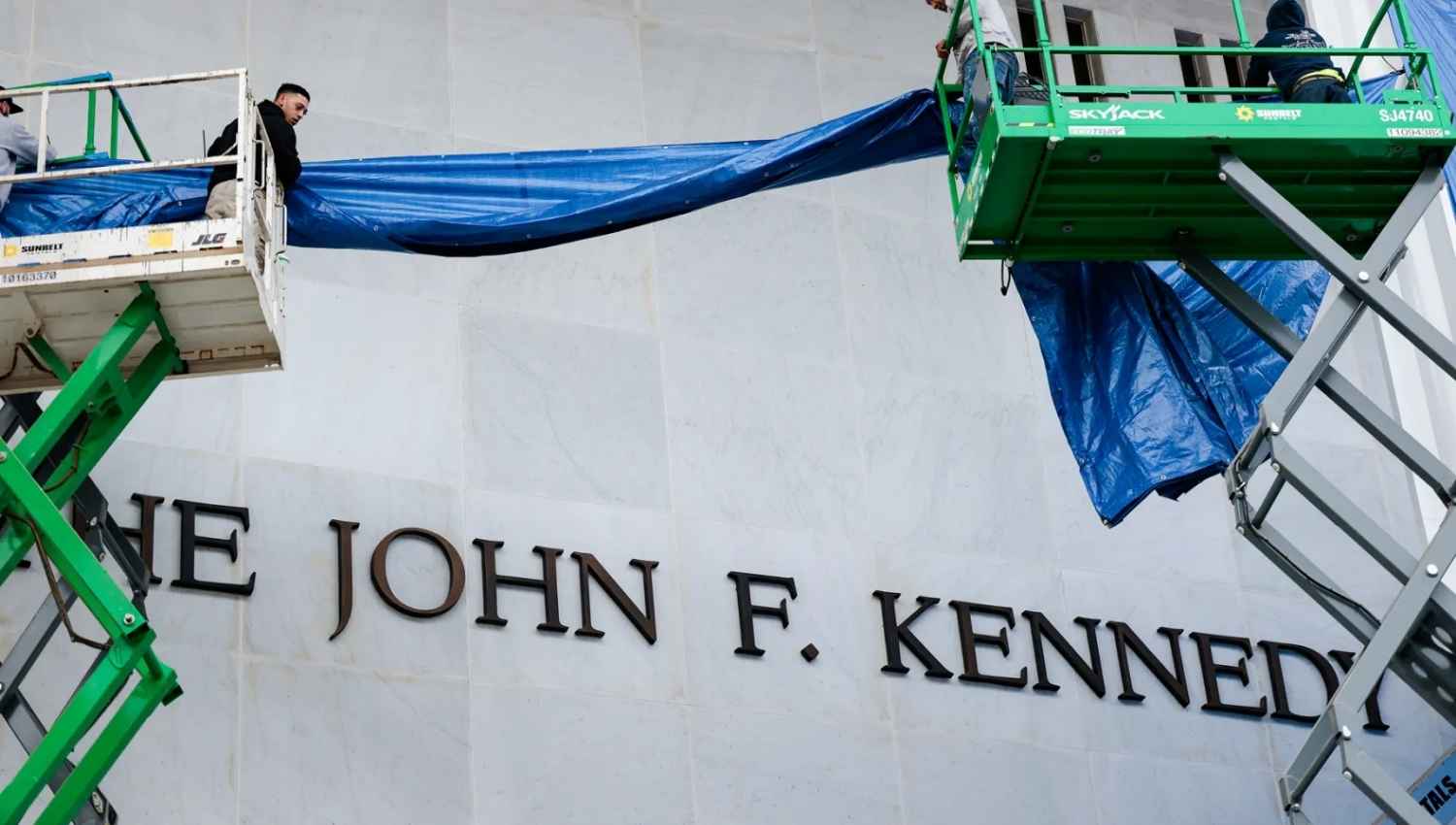
On June 13, workers arrived to take the name down. Staff, NSO musicians fresh off a performance, and visitors gathered to watch, though the work amounted to hanging a tarp. At the time of writing the tarp remains, and on July 8 an appeals court rejected Trump’s attempt to halt the removal.
Even so, Trump remains tied to the Center. There has been no discussion of his stepping down as chairman or of removing the board members he appointed. Were he to leave office tomorrow, he would still hold the chairmanship. The board would have to vote him out, something his supporters are unlikely to do, and nothing in the current bylaws prevents the post from becoming effectively permanent or being passed down.
What has been lost
The closure is already underway. A May 27 staff email laid out instructions for archiving, destroying, and transferring materials to the Kennedy Center Archives. Spaces once covered in posters for upcoming shows now display long-past performances, a quiet reminder of what came before. No wrecking ball has arrived, yet the building is a shadow of what it was.
The losses run well beyond money. They include the performances and commissioned works planned for America’s 250th anniversary, the first-time visitors who would have marveled at the design, and the shared experience of a sold-out hall.
To reverse the decline, Congress would need to amend the bylaws to remove Trump and his appointees and to bar presidential interference for good. Only then, supporters argue, could the harder work begin of restoring the Center’s standing and reviving the artistic legacy first envisioned by Presidents Eisenhower and Kennedy.