

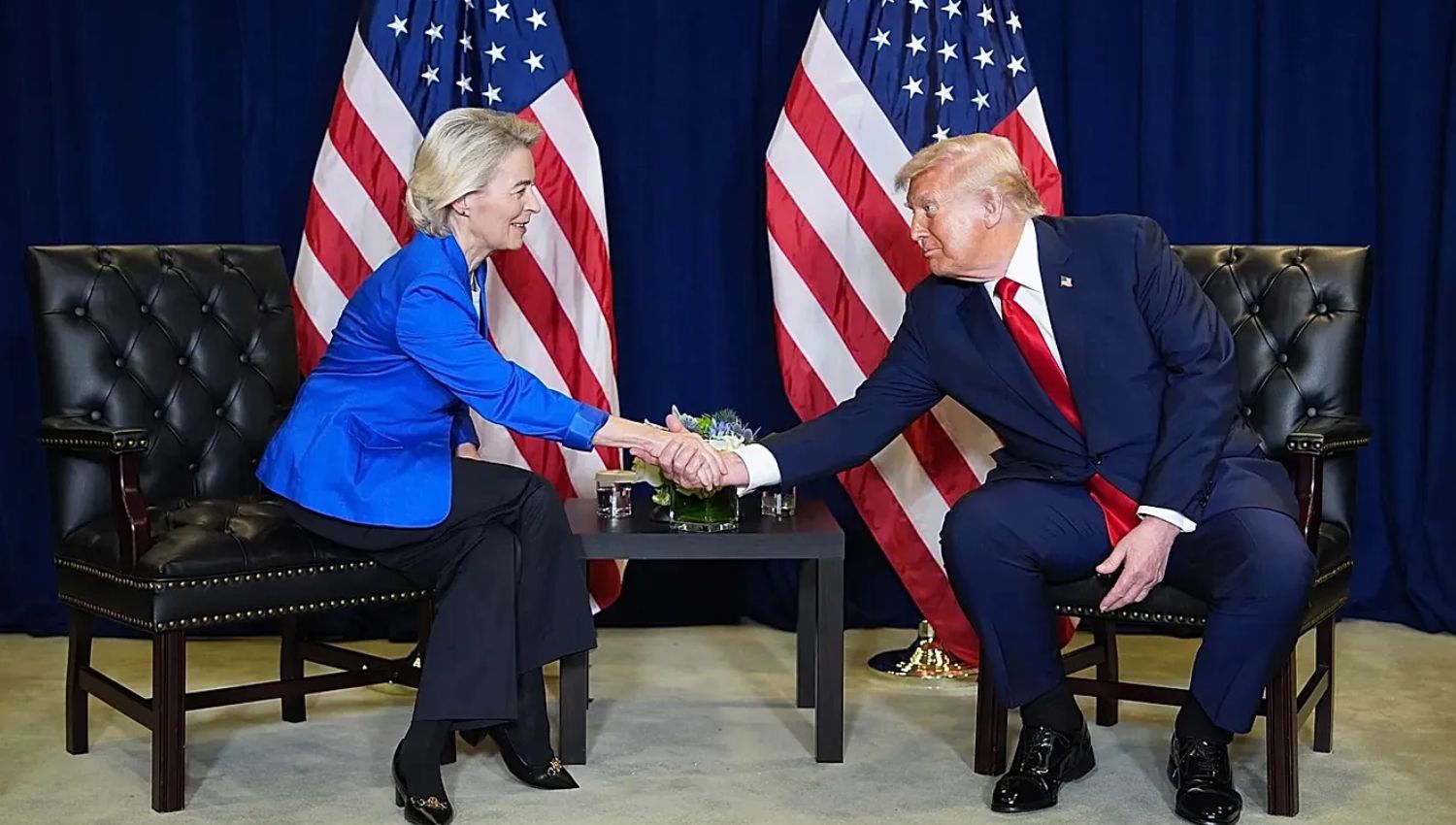
Twelve months on from the handshake in Scotland, a €890 million fine on Google has the White House talking retaliation. The EU, this time, has written itself an exit.
The EU-US trade deal turns one under a cloud. A year after European Commission President Ursula von der Leyen and US President Donald Trump reached their agreement at Turnberry, Scotland, the transatlantic relationship is being rattled by a fresh round of threats from Washington.
The trigger was last week’s €890 million fine the Commission imposed on Google, which infuriated the Trump administration. Writing on Truth Social, the president said the US would open investigations into unfair trade practices, a signal that his administration intends to hit back when the EU applies its digital rules to American companies.
Trump may find the response is not one-sided. After months of talks on implementing the Turnberry agreement, which sets 15% US tariffs on EU goods and scraps EU duties on US industrial products, the Europeans built in safeguards letting them put tariffs back on American goods in defined circumstances.
What Washington said after the Google fine
Two warning shots followed the announcement. On Thursday night, US Trade Representative Jamieson Greer said the fine created “uncertainty” around the Turnberry deal and threatened the EU-US dialogue on European digital rules.
Trump escalated the next day. “The United States of America is not a ‘PIGGYBANK’ for Europe, nor will we allow it to be!” he posted, before confirming his administration would launch a Section 301 investigation under the US Trade Act of 1974, the mechanism the federal government uses to go after unfair trade practices by other countries.
“The European Union will pay a very big price for this illegal and highly unethical conduct, which I have consistently warned them about,” he wrote. “Stay tuned!”
Is the threat real?
Europeans have had a year of social media threats from Trump and mostly stopped reacting to them. In December 2025, Washington threatened EU tech companies including Accenture, Siemens and Spotify with restrictions or fees if the bloc kept regulating US Big Tech. The Digital Services Act and the Digital Markets Act have drawn repeated criticism from the administration since it returned to power, framed as non-tariff barriers aimed at American firms.
German Socialist MEP Bernd Lange, the European Parliament’s trade chief, was non-committal. “Let’s see what time will bring,” he told Euronews, noting that talks with the US on EU digital regulation are ongoing but that he could not say whether they would produce anything “concrete”. If Trump is serious, Lange thinks the US could go after EU digital services.
The escape clause
On 19 May, after hours of negotiation, member states and the European Parliament agreed to remove EU tariffs on US goods from 1 July. Lawmakers insisted on safeguards to protect EU businesses from exactly this kind of pressure.
The Commission can now suspend the deal if Washington breaches the 15% ceiling, or if it “undermines access of Union economic operators to the United States’ market, discriminates against or targets Union economic operators aiming to operate, or already operating, in the United States”. The regulation scrapping EU duties allows suspension too if the US “disrupts the trade and investment relationship between the Union and the United States.”
Croatian conservative MEP Željana Zovko said the power to suspend has “rightly been entrusted to the Commission.” She added: “I am confident it will act at the right time and on the basis of facts.”
Who would actually pull the trigger?
The Commission’s recent posture suggests tolerance. New US tariffs appear acceptable to Brussels so long as they stay under the 15% ceiling.
That was borne out on Friday, when a new US tariff regime replaced the one introduced after a February ruling by the US Supreme Court. The EU executive was content with the new rate of 10%, despite the tariffs being justified by claims that the bloc has failed to block imports made with forced labour. The EU rejects that, pointing to strict rules already in place.
Services are the sharper question. Lange said the Commission has agreed to factor in Parliament’s position should suspension come onto the table. “So if we are pushing for the suspension, then I guess they will do it as well,” he said, arguing there would be enough political will in Parliament to back it.
“We have much more self-confidence than a year ago.”