

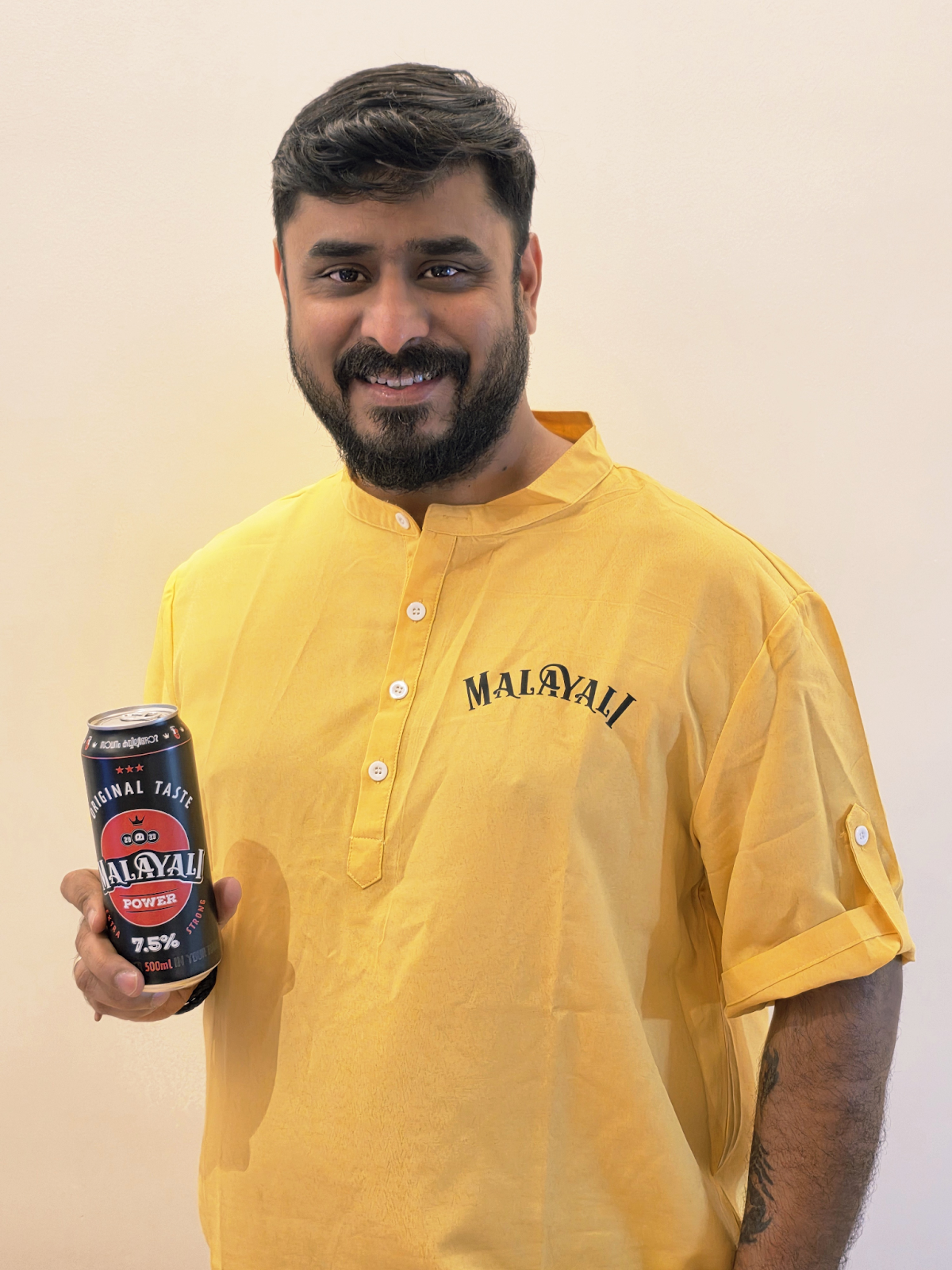
When Chandramohan Nallur began selling beer from Poland to international markets, it was not the outcome of a long-standing plan to enter the alcohol business. It was a response to a logistical constraint. In the early months of the Russia–Ukraine war, a shipment of Indian rice flakes became stranded as supply chains across Eastern Europe fractured. Rather than write off the loss, Nallur and his team at Hexagon Spirits International explored how the raw material might be repurposed.
The result was Malayali Beer, a hybrid lager that combines European hops with Indian rice flakes and has since grown into a globally distributed brand. Launched less than three years ago, Malayali Beer is now sold in 25 countries across Europe, the Middle East, Southeast Asia, and Oceania. The company has crossed one million cans in sales, secured placements in duty-free outlets at three major international airports, and in 2025 earned Gold and Bronze medals at the World Beer Awards for its lager and non-alcoholic variant.
“I didn’t start out wanting to build a beer company,” Nallur said. “This happened because we had to solve a problem. Only later did we realize that the solution could travel much further than we expected.”
From its base in Poland, Malayali Beer occupies an unusual position in the global beverage industry. It is a young brand operating without the backing of a multinational conglomerate, founded by a non-drinker, and shaped by an approach that emphasizes adaptability over heritage. Its growth reflects not only entrepreneurial improvisation but also broader shifts in how beer is brewed, consumed, and marketed across borders.
An Accidental Beer, Born Of Constraint
Malayali Beer emerged from a moment when flexibility mattered more than long-term strategy. With traditional routes blocked and inventory stranded, Nallur’s team experimented with combining Czech-style brewing techniques, European hops, and Indian rice flakes. The formulation produced a lager that behaved differently from many established brands.
Consumers responded first to its texture and drinkability. Many reported that the beer paired more comfortably with food and caused less bloating, a small but meaningful distinction in markets where beer is commonly consumed alongside meals. What began as an improvised solution gradually became the brand’s defining feature.
“We didn’t set out to solve a physiological issue,” Nallur said. “But once people started telling us the same thing again and again, we understood that this was something worth paying attention to.”
The company expanded the concept into a broader portfolio. Malayali Lager became its strongest seller in Europe, Malayali Power found traction in the Middle East and Southeast Asia, and a non-alcoholic variant, Malayali Habibi, opened doors in markets with stricter regulations or shifting consumer preferences. Within two years and nine months, the brand crossed one million cans sold and reported annual revenues of approximately €1.3 million, with year-on-year growth of around 600 percent.
Brewing Identity Across Markets
The name “Malayali” reflects more than regional origin. While rooted in Kerala’s cultural identity, it also signals movement and diaspora. Nallur, who has lived and worked across multiple countries, views the brand less as a national export and more as a global expression of adaptability.
“Malayali is not just a place,” he said. “It’s a way of navigating the world. People move, tastes travel, and products have to make sense in more than one context.”
Hexagon Spirits International operates with a distributed model, working with producers and partners across regions rather than owning large centralized facilities. This structure allows the company to respond quickly to regulatory differences, supply conditions, and local demand. It also reflects a broader shift within the beverage industry, where agility is increasingly valued alongside scale.
Competition remains intense. Established brands such as Kingfisher and Cobra dominate the Indian-origin beer narrative internationally, supported by decades of distribution networks and marketing investment. Malayali Beer’s differentiation lies not in heritage or volume, but in specificity. Its hybrid brewing approach challenges traditional assumptions about purity and provenance in beer-making.
Nallur sees this as an advantage rather than a risk. “The industry often celebrates where something comes from,” he said. “We focus on how it fits. With food, with different cultures, and with different drinking habits.”
A Teetotaler’s Perspective On the Alcohol Business
One of the more unusual aspects of Nallur’s profile is personal. He is a teetotaler. He does not drink the products his company sells.
That distance, he argues, has influenced both decision-making and product development. Without relying on personal taste, he depends heavily on consumer feedback, market data, and distribution insights. It has also shaped the company’s approach to non-alcoholic beverages, a category gaining momentum globally as drinking patterns evolve.
“Not drinking forces you to listen,” Nallur said. “You can’t design the business around yourself. You have to understand why other people are choosing your product.”
Malayali Habibi’s success in the Middle East and other regions where alcohol consumption is limited suggests that this perspective has commercial value. It also hints at how the company may grow in the coming years, not only through traditional beer markets but through alternatives that align with moderation trends.
Looking ahead, Nallur is preparing to enter North America, Africa, and China. Each expansion brings regulatory complexity and competitive pressure, particularly for a young brand without the resources of a global brewer. Still, he remains pragmatic about the challenges.
“Every market has constraints,” he said. “This business exists because we learned to work within them.”
In a beverage industry often shaped by consolidation and legacy, Malayali Beer’s rise offers a different case study. It is a company built from an unplanned response to disruption, scaled through hybrid identity and operational flexibility, and guided by a founder whose distance from consumption has sharpened his focus on fit and function. Whether that approach can sustain growth across new continents remains to be seen, but its early trajectory suggests that, for now, adaptability may be as important as tradition in determining what travels well.