

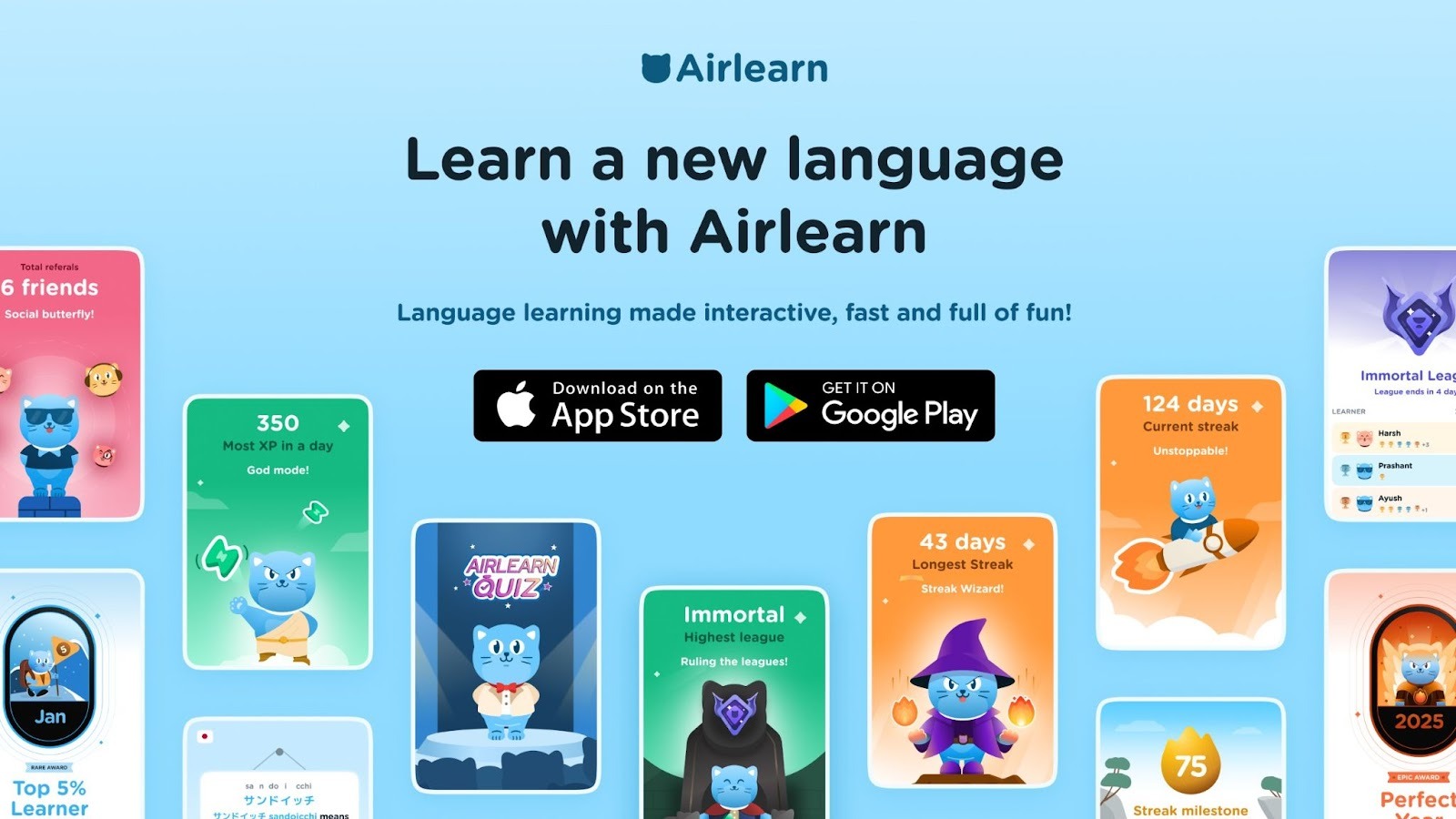
The familiar green owl has long defined how millions start learning languages on their phones. Now, a quieter contender is shifting the focus from points and streaks to speaking skills, grammar, and cultural context. Airlearn trades micro-game mechanics for conversation-first lessons enriched with cultural notes before practice drills. The app’s approach has earned strong approval, with ratings of 4.8 on Apple’s App Store and 4.7 on Google Play from 18K+ reviews within just a year from its launch.
Conversation Focus
Airlearn’s lessons follow a “learn first, practice next” structure, starting with a brief grammar summary and examples before moving into practice slides simulating everyday dialogue. This method contrasts with the micro-game focus of many popular language apps, aiming to help learners bridge the gap between classroom knowledge and real-world conversation.
Educational research reinforces this approach, showing that meaningful exchanges build both retention and confidence. User reviews and video comparisons reflect the same sentiment, with many learners praising Airlearn’s emphasis on coherent speech and contextual practice.
Learning Design
Publicly available resources and app descriptions show that Airlearn blends grammar instruction, cultural context, and conversational role-play into a single flow. Lessons present brief grammar modules alongside practice dialogues, introducing sentence structures within communicative scenarios rather than as isolated drills. Cultural notes such as formal versus informal address in French, business greetings in Japanese, and practical dining phrases for Spanish-speaking contexts appear before role-play, giving learners social norms and idioms to apply immediately.
User feedback on app stores and social platforms often highlights these cultural and contextual elements as useful for real-world conversations. Company leadership has also announced a forthcoming AI conversational tutor designed to give pronunciation and usage feedback.
Engagement And Metrics
Airlearn’s spokesperson reports rapid adoption, signaling strong appeal to learners seeking more than gamified repetition. The company highlights that it now has 2 million users across 150 countries, with 10 million lessons completed in the last 30 days. Airlearn is also trending in the Top 10 charts on the App Store and Play Store in over 100 countries on most weeks.
These metrics suggest that more language learners are drawn to Airlearn’s conversation-first approach, encouraging sustained practice and prompting many to switch from language learning apps like Duolingo.
App store listings detail the app’s access model and language range. Free users can complete a set number of daily lessons, while paid subscribers unlock unlimited access to all lessons. Listings also show support for more than 20 languages, offering breadth for learners who want depth and variety under one subscription.
Leadership And Strategy
Airlearn’s leadership brings deep expertise in building and scaling education platforms. The company was started by Gaurav Munjal, Co-founder of Unacademy, one of Asia’s leading edtech companies. Backed by this track record, Airlearn is built on a conversation-first, culturally grounded model designed to solve the shortcomings of vocabulary-heavy, gamified apps.
Drawing on Unacademy’s success and resources, Airlearn is refining its technology and tailoring it for key markets like the United States. The vision is clear: to become the most preferred language app globally by offering authentic, real-world conversational fluency that goes far beyond passive drills.
This leadership foundation gives Airlearn a distinct edge. With proven experience, strong investment, and a bold roadmap that includes innovations like the upcoming AI Tutor, Airlearn is positioned not as an alternative, but as a serious contender reshaping how people around the world learn languages.
Positioning Against Incumbents
Airlearn presents itself as the logical progression for language learners who want to move beyond memorizing vocabulary to developing real spoken confidence. Its lessons integrate grammar and cultural context directly into conversation practice, providing learners with the tools to speak naturally and accurately. This approach stands in contrast to the gamified, point-driven models popularized by earlier mass-market apps, offering a more meaningful and effective learning experience.
The steady shift of learners to Airlearn highlights a clear demand for a language app that prioritizes real conversation. By integrating grammar, cultural context, and practical dialogue, Airlearn provides a meaningful alternative to gamified apps and is establishing itself as a serious contender in the global language learning market.
AI Tutor Launch
Airlearn has now added an AI Tutor to extend its conversation-first model. The Tutor simulates real dialogue, letting learners practice speaking, ask questions, and get instant feedback at their own pace. By turning lessons into interactive exchanges, it offers a scalable way to build confidence, something most language apps struggle to deliver.
“At Airlearn, our mission has always been to make language learning truly conversational. With the Airlearn AI Tutor, we’re creating an experience that feels human, helps learners progress faster, and sets a new standard for what’s possible in language learning”, said Gaurav Munjal, Founder & CEO, Airlearn.
For further information please contact:
press@airlearn.com