

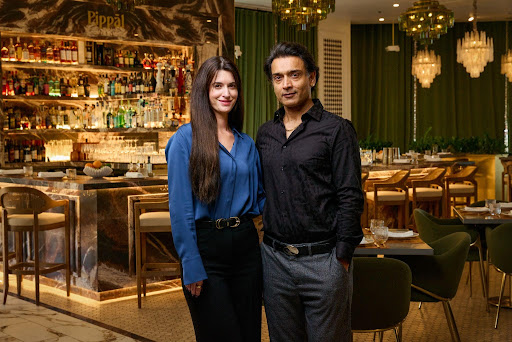
Carolina and Jatin Grewal are not the kind of restaurateurs who stumbled into the business. Carolina, a former actor and model, carries an instinct for atmosphere and narrative that most food entrepreneurs simply don’t bring through the kitchen door. Jatin brings the culinary conviction. Together, the California-based couple has spent years quietly reshaping what Indian cuisine looks like on the American plate — and the culinary world is starting to pay attention.
From Performance to the Plate: A Vision Rooted in Story
The Grewals’ California restaurants have been drawing diners who arrive expecting something familiar and leave having experienced something closer to a culinary passport. Their menu reads less like a standard Indian restaurant bill of fare and more like a carefully charted expedition. It moves through the subcontinent’s lesser-known regions, surfacing dishes rarely encountered outside of India itself. The food is elevated. But the intention runs far deeper than the plate.
What the Grewals are after is feeling. Their restaurants were conceived as spaces where guests shed the weight of the ordinary — where the room’s warmth and elegance conspire with the food to create something closer to transport than a typical dinner. That vision draws from Carolina’s background in performance and visual storytelling. She reads a dining room the way a director reads a set: every element placed with purpose, every detail in service of the larger experience.
The cocktail program mirrors that same philosophy. Drinks are crafted around Indian botanicals and regional flavors, positioned alongside the food rather than treated as an afterthought. The bar becomes part of the narrative — another chapter in a story that begins the moment a guest steps inside. For Jatin, the menu is a living document. It breathes with the seasons, with the sourcing, with whichever region of India happens to be calling to them at any given moment. The result is a dining experience that resists repetition.
Importantly, the Grewals are not serving a softened version of Indian cuisine made palatable for cautious American palates. They are offering the real thing — unfamiliar spice combinations, regional techniques, and flavor profiles that ask the diner to meet them somewhere new. That willingness to push, and trust that diners will follow, is perhaps what most sharply separates them from the category they’re redefining.
A Cuisine Long Overdue for Recognition
For decades, Indian food in America occupied a particular lane: affordable, abundant, and beloved — but rarely accorded the reverence given to French, Japanese, or modern Peruvian cuisine. The tasting menu circuit, the Michelin universe, the glossy magazine spreads — these were territories largely closed to Indian cooking, regardless of its extraordinary depth and regional complexity. A culinary tradition spanning thousands of years, dozens of distinct languages, and hundreds of regional styles had been flattened into a single serviceable category in the American dining imagination.
The tide has begun to turn, and the momentum is considerable. A growing wave of chefs and restaurateurs across the country has pushed Indian cuisine into genuinely rarefied air over the past several years. The James Beard Foundation has taken notice. Food media has followed in force. According to a 2023 report from the National Restaurant Association, Indian cuisine ranks among the fastest-growing categories in American upscale dining. The question being posed now is no longer whether Indian food belongs at the fine dining table. It is why it was kept waiting so long.
The Grewals occupy a distinct position within the wider reckoning. Where some contemporaries have leaned into fusion or spectacle, their restaurants hold tightly to regional authenticity — presenting specialties that most American diners have never encountered, rendered with the care typically reserved for omakase counters or tasting room experiences. The competition is meaningful: names like Dishoom and the Etan Group have done serious work expanding Indian cuisine’s cultural footprint in upscale markets. The Grewals are carving a path that feels more intimate and more deliberately personal — driven less by trend than a genuine need to tell a story.
What makes their position particularly compelling is the source of that story. Carolina’s experience in front of the camera — studying character, atmosphere, and the way a space communicates — translates directly into how a dining room is read. A great dining room, like a great performance, lives or dies on the ability to hold a person’s attention and make them feel something. The Grewals understand that intuitively, and it shows.
Building Something That Endures
California proved the concept. Nevada is next. The Grewals are preparing to carry their vision beyond the Bay Area, with expansion plans that reflect a growing national appetite for dining experiences that offer more than just a satisfying meal.
The ambition here is not scale for scale’s sake. The Grewals have been open about wanting each restaurant to feel like a direct extension of who they are — their aesthetic sensibility, their warmth, their cultural inheritance. That kind of personal imprint is rare in the restaurant world, where expansion so often erodes the very edges that made a place worth visiting. Staying true to an identity while growing is one of the hardest problems any restaurateur faces. The Grewals appear to have thought seriously about how to navigate it.
Their story speaks to something larger than one couple’s ambition. Fine dining in America is in the middle of a genuine reckoning — with whose cuisines get elevated, whose techniques get called “refined,” and whose culinary heritage gets taken seriously. The Grewals didn’t lobby for inclusion. They walked in with a clear vision, a strong aesthetic, and the kind of quiet confidence that tends to make rooms pay attention. Indian cuisine, in their hands, is no longer waiting for recognition. It is demanding it — and getting it.