

In most fast‑growing companies, the workday begins and ends inside a tangle of inboxes. Email, Slack, WhatsApp, LinkedIn, Instagram, Teams: each window promises opportunity and hides risk. The executives responsible for keeping those companies alive now spend hours every week scanning for the one message that could alter a quarter, a fundraise or a career. It is increasingly unclear who is in charge—the people, or the feeds.
That confusion has become more than a personal frustration. Between 2024 and 2025, global email traffic climbed into the hundreds of billions of messages sent daily, while business messaging on SMS and chat platforms grew into the trillions annually. Analysts expect both curves to rise steadily toward 2030. The tools that enabled constant connectivity have delivered a new scarcity: focused attention. The question facing founders and their investors is no longer whether they miss important signals, but how many, and how often.
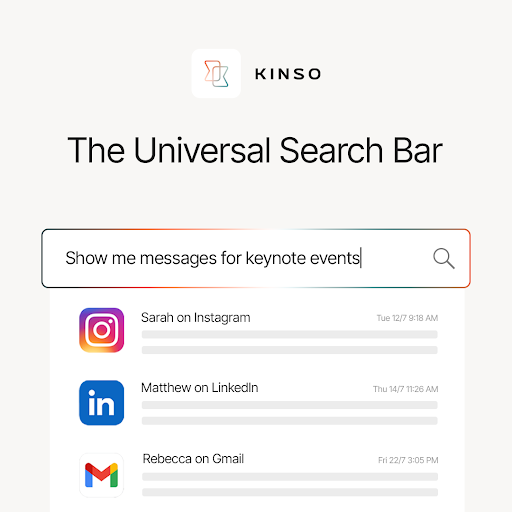
Kinso, a young Australian company founded by brothers Frank and Jacques Greeff, exists in that gap. Their product is a “universal inbox” that connects to email and the major messaging and social platforms, then uses artificial intelligence to reorder everything a user sees. Instead of a chronological list, Kinso presents a ranked stack of conversations, arranged by how much they appear to matter to fundraising, revenue, hiring or key relationships. The pitch is stark: if every message is data, then there is no reason the most important ones should be buried.
Signal in a crowded industry
The timing of Kinso’s emergence is not accidental. Over the past two years, the technology industry has been absorbed by what might be called the “LLM wave,” as large language models spread into search engines, office suites, and customer support systems. The most visible applications have focused on generating text, images or code. Less noticed, but just as consequential, is a quieter contest over how those models will interpret the flood of communication already flowing through companies.
That contest has been sharpened by a series of events within telecommunications and enterprise software. Forecasts published in 2024 and 2025 describe a steep rise in conversational business messaging, as banks, retailers and logistics firms nudge customers into two‑way exchanges rather than one‑off alerts. Email providers, facing both higher volume and stricter filtering, have responded with new algorithms to separate transactional mail from what users are likely to ignore. The result is an environment in which intent is harder to see, even as more messages carry commercial weight.
Kinso positions itself at the edge of those trends, but not as a mass‑market app. Its target users are founders, investors and senior operators who juggle investor updates, hiring threads, customer escalations and partnership pitches across half a dozen channels. For those people, a missed message is not just an annoyance; it can mean a lost term sheet or a damaged account. The company’s argument is that if artificial intelligence can summarize documents and write code, it should also be able to tell an exhausted chief executive which conversation to open first.
At the core of Kinso is an ingestion engine that pulls messages from email, chat and social platforms into a single store. Instead of labeling them only by sender or subject, the system looks for connections: mentions of the same person or company, similar topics, repeated questions. Threads about a pending funding round, for example, might stretch from formal email to casual messages on WhatsApp and remarks in a private Slack channel. Seen through one interface at a time, those fragments can be easy to ignore. Seen together, they form a pattern.
From “inbox” to opportunity map
Pattern‑finding is what gives the product its strategic ambition. Once messages are grouped by people, themes and events, Kinso applies ranking. The models behind that ranking are tuned not to generic “importance” but to specific kinds of opportunity. A short note from a key customer or investor may be elevated above dozens of routine updates. A quiet warning about a delayed payment or a candidate’s competing offer can appear near the top of the daily view, rather than disappearing into the middle of a feed.
Around that core, the company has built features that treat the inbox less as a record and more as a planning tool. Users can ask natural‑language questions—about what a certain person last said, where a particular deal stands, which introductions were promised but never made. The system answers by assembling excerpts across channels, then presenting a concise recap. Before meetings, it can generate brief dossiers that surface unresolved commitments and personal details that matter in negotiation or hiring.
Advocates see in this approach the outline of a new kind of workflow. Instead of starting the day by clearing notifications, an operator might begin with a short briefing: the five threads that deserve attention, the three that seem to be slipping, the one relationship that has gone quiet. Replies can be drafted automatically in the user’s style, then approved or edited. Requests that match someone in the user’s network can trigger suggestions for warm introductions. The routine labour of remembering, searching and drafting is delegated; the remaining work is judgment. The vision carries risks. Any system that sits in the middle of sensitive communications raises questions about privacy and control. Kinso’s public materials stress encryption, limited data sharing and a refusal to use customer conversations to train external models, but many executives remain cautious about granting another layer of software access to their deal flow. There is also the danger of over‑reliance: a ranking algorithm that misjudges what matters could hide the very messages it is meant to highlight.
A crowded race for the same advantage
Kinso is entering a field already populated by larger firms. Major email and productivity suites now include AI “assistants” that summarize threads and suggest replies. Customer relationship management systems stitch together emails, calls and notes into unified timelines. Help‑desk platforms offer shared inboxes with automated triage for support teams. Each of these products claims, in its own way, to surface what matters and automate the rest.
Where Kinso differs, at least in its self‑description, is in its insistence on channel neutrality and role specificity. It is not bound to a single email client or chat app, and it is not limited to customer‑facing scenarios. A founder’s messages from investors, employees, customers and peers are treated as one network. Within that network, the AI looks for leverage: places where a quick response, a timely introduction or a well‑timed follow‑up might shift an outcome. The product is less a tool for managing customer tickets than a map for managing power and opportunity.
Behind the software lies a deliberate narrative. The Greeff brothers built and sold a previous company in a sector—real‑estate technology—where timing and relationships often determine who wins a deal. They are now, in effect, instrumenting the rhythms they once navigated by instinct. Their own workday, by their account, is run through the product: investors, journalists, early customers and job candidates all appear in the same ranked list.
The industry context suggests that such experiments will multiply. As message volumes rise through the end of the decade and companies cut back on headcount, the ratio of communication to decision‑maker will only widen. It is unlikely that people will check fewer apps or abandon channels that customers prefer. The leverage, if there is any to be had, will come from tools that can quietly reorder the flood in ways human beings agree are sensible.
Whether Kinso will be one of those tools is an open question. Its models will have to perform in noisy, high‑stakes environments. Its privacy guarantees will have to survive scrutiny from legal and security teams. Its users will have to decide whether the new habit—trusting an algorithm to decide what they see first—feels empowering or unnerving. The company’s own future depends on the answer.
For now, the most striking thing about Kinso may be what its existence implies. If an entire business can be lost inside fragmented threads and unread messages, then the inbox is no longer a personal annoyance but a balance‑sheet risk. Turning every message into a potential edge is an ambitious promise. It is also an acknowledgment that the competition for scarce attention has moved, decisively, to the center of modern work.