

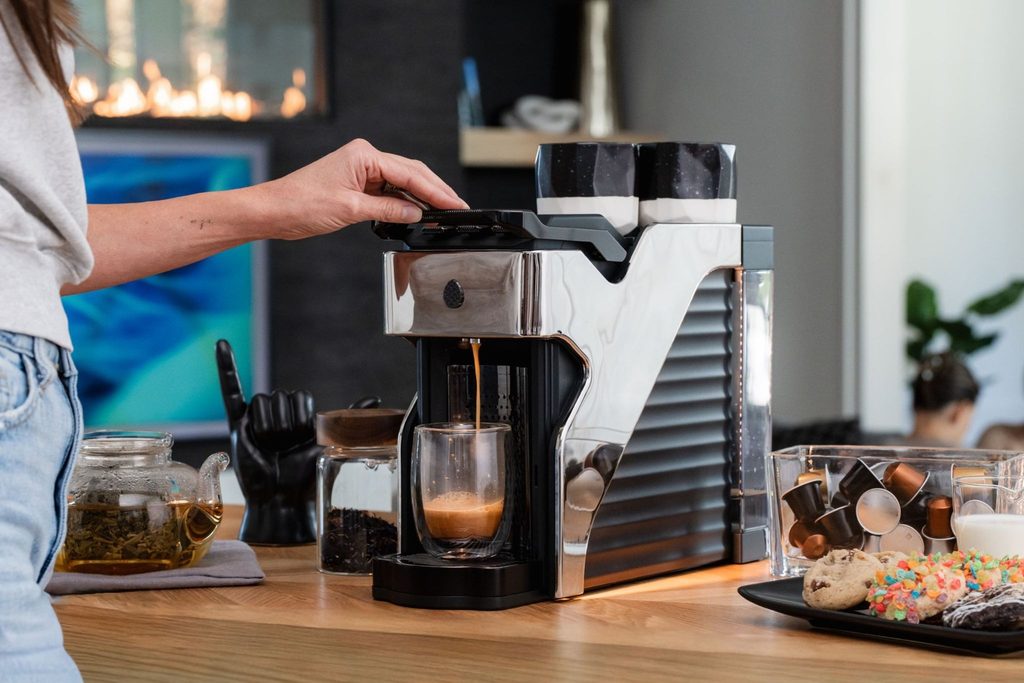
Byline: Shem · Photo courtesy of Milton Coffee Co.
The specialty coffee world doesn’t like to admit this: most people who love good coffee will never make it the way specialty coffee says they should. They won’t buy a scale or learn to weigh a dose. They won’t time a shot or work out what grind setting suits a new bag of beans. They’ll still know right away whether a cup is good.
For years the industry has treated these people as future converts, enthusiasts who just haven’t bought the gear yet. Milton Coffee Co. treats them as the main market.
The company, based in Milton, Georgia, makes the Line1, an espresso machine designed around this customer. Founder Matt Kossoff’s starting point was that the people who want great coffee and the people willing to work for it are two different groups. The second group is small. The first is very large, and Kossoff believes it has been underserved.
“The vast majority of people who want great coffee are not enthusiasts,” Kossoff says. “They’re busy, practical people who don’t have the time or interest to become home baristas, but still care about quality, design and how things fit into their daily lives.”
Those drinkers have usually faced a trade. They could choose convenience, which often meant a capsule machine built with plastic internals and coffee chosen mainly for price. Or they could chase quality with equipment that takes time, practice and daily attention. Milton’s position is that the trade was never necessary. It came from how the machines were built.
The Line1 runs on Nespresso OriginalLine-compatible capsules, a format millions of households already use. Everything around the capsule is different. The brew path is stainless steel rather than plastic, in a system the company describes as the first of its kind in a pod-based machine. The Line1 uses pre-infusion to improve extraction and rinses itself after every brew. There’s no app, nothing to calibrate and no setting that can be left in the wrong place.
The coffee changes too. Milton curates capsules from nearly 30 independent specialty roasters around the world, many of whom had little or no presence in the United States. Some have had coffees on the World Barista Championship podium. Coffee that once meant a trip to a particular café, or a serious setup at home, now arrives sealed in a capsule that works in a machine the owner can use half awake.
The roasters see the sense in it. According to Kossoff, many of Milton’s partners recognize that demand for great coffee is high, while the number of people prepared to grind, dose and dial in espresso at home stays limited. For them, a well-made capsule and a well-built machine are a way to reach everyone else without lowering their standards.
Kossoff is careful not to dismiss enthusiasts or the companies that make equipment for them. He has spoken respectfully about super-automatic brands such as Jura and De’Longhi, while pointing out that those machines still depend on beans, grind and calibration. His argument is simply that most people will never want to manage those variables, and shouldn’t have to in order to drink something excellent.
Early customers seem to agree. During Milton’s pre-launch phase, the company reported just over 100 pre-orders without any paid marketing, spread across ready-to-ship and fully customized machines. The custom builds are finished by hand in Georgia in materials such as wood, leather and hand-hammered metal, a sign that this customer cares how the machine looks as much as how the coffee tastes.
There’s something respectful about the approach. Milton doesn’t ask its customers to become different people, pick up a new hobby or prove they deserve good coffee. The Line1 fits into the morning they already have.
For many of those drinkers, that may be the first time a specialty coffee product has been designed with them in mind. Specialty coffee has long rewarded the people who put in the effort. Milton is building for the people who never will, and Kossoff thinks they far outnumber the enthusiasts.