

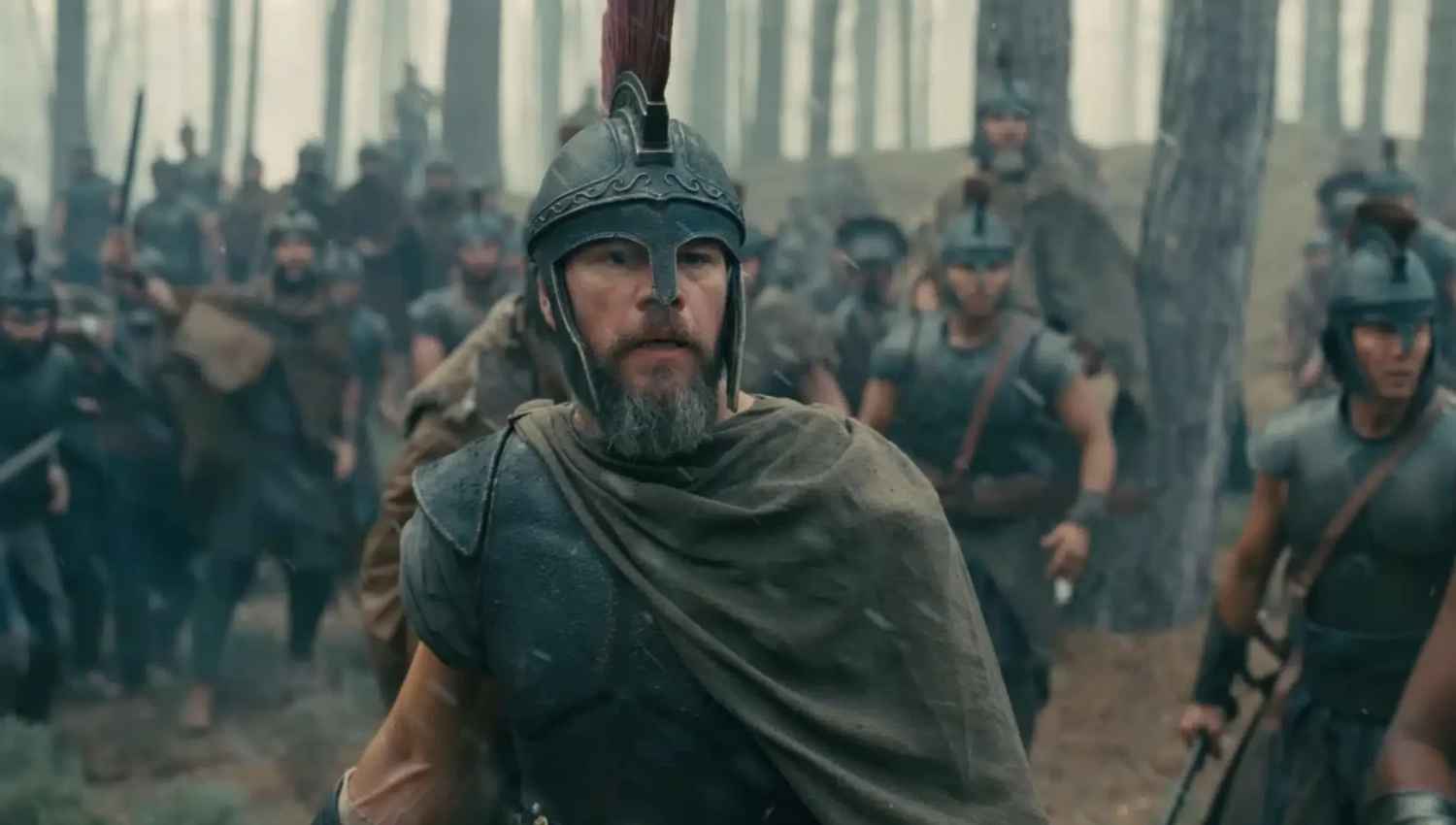
Christopher Nolan’s take on Homer arrives with everything a blockbuster could ask for, a marquee cast, monumental visuals, and one of the most famous stories ever told. Yet for all its scale, “The Odyssey” struggles to justify itself. There’s a nagging sense that the film only fully clicks for viewers who already know the “Odyssey” and the “Iliad” intimately, and if a movie depends that heavily on its source material, something in the translation has gone wrong. Nolan even seems to wink at this, with one line in the film inviting the audience to fill in the gaps themselves.
Whatever motifs Nolan borrowed from Homer, the film is ultimately about modern men adrift in an ancient world. It circles toxic masculinity and its mirror image in toxic femininity, the cost of sacrifice, the seductive pull of false narratives, the arrogance of conquering powers, and the erosion of faith and innocence in wartime. Beneath all of it runs a meditation on trauma and its aftermath.
A director caught between worlds
An opening title card promises a story about plain, visible magic, and there’s irony in that framing. Nolan has never shied away from illusion, but here he seems reluctant to fully embrace the fantastical creatures the myth demands. When he does commit, the results are striking. In an era saturated with weightless CGI monsters, his behemoths land with real menace, and his only faintly glimpsed sirens become genuinely unnerving precisely because they stay at a distance.
The Cyclops is the standout, staged like a Goya nightmare brought to life, its movements fluid yet deliberate in a way that recalls the stop-motion creatures of Ray Harryhausen. Odysseus and his men creep into its cave as invaders trespassing where they don’t belong, realizing too late that the giant can speak. When one of them asks why they hadn’t known, Odysseus answers with cold indifference, framing themselves as insignificant to a being that towers over them. These are the sequences that briefly revive the leaner, scrappier Nolan of “Batman Begins” and “The Prestige,” the filmmaker he was before the IMAX blockbusters took over.
The performances
Too often, though, the film feels like an Ed Zwick picture with a bigger budget, or a Ridley Scott production with slightly sharper direction. Matt Damon’s Odysseus returns from a decade of wandering looking like a weathered elder statesman, yet slips back among people who somehow fail to recognize him, a conceit that reads better on the page than on screen.
Anne Hathaway’s Penelope quietly claims her own victory in a contest of her own. Tom Holland, as Telemachus, risks being permanently boxed into the role of the son. Mia Goth, fresh off her rise in the “Maxine” films, is handed a role so slight it borders on a cameo, the kind of casting Nolan can afford to indulge. Robert Pattinson, meanwhile, seems to be enjoying a part that never taxes him the way “The Lighthouse” did. Charlize Theron’s Calypso is styled and made up so pointedly that her character’s name doubles as commentary, and it’s she who suspends Odysseus in a dreamlike limbo reminiscent of “Inception.”
The casting drew ugly reactions online, with Lupita Nyong’o targeted by racist abuse over her turn as Helen of Troy and Elliot Page subjected to transphobic hate for playing Sinon. Those attacks are indefensible, and they pull focus from what may be the film’s real center of gravity, Jon Bernthal’s Menelaus. Bernthal, forever cast as the alpha, plays an ambivalent father figure for the searching Telemachus, while Agamemnon (Benny Safdie) appears as a faceless figure of armor and helmet, a man rendered as a god or as an unreachable ideal of manhood.
Myth and masculinity
Calypso’s parting advice to Odysseus, to stop fighting and simply live, sets up the film’s central irony. After his triumphant return, he still performs the role of a beggar for his own queen, spinning a legend of his own heroics before theatrically revealing himself. It’s a story rooted in an old idea of women defined entirely by the men around them. In the end, Odysseus doesn’t stay. He chooses his lost soldiers over his family and sails off to find them, a reflection of how veterans often seek understanding among those who shared their suffering rather than at home. A telling scene hints that the companions he selects were the least suited for the voyage, quietly undercutting his reputation for wisdom, even as Telemachus takes the throne.
Damon has been a fairly static presence for years, and it’s tempting to imagine what a more magnetic actor might have brought to the part. Sean Bean’s sly, grinning Odysseus in Wolfgang Petersen’s “Troy” offered a lightness this grim version lacks. There’s a case to be made that Achilles was always the more compelling figure anyway. Notably, Nolan himself once came close to directing “Troy,” and it’s easy to imagine his version arriving at a similar destination.
From auteur to monument builder
The larger question hanging over the film is why Nolan no longer makes smaller movies. Since “Interstellar,” he has reached repeatedly for the epic, overcomplicating “Dunkirk” with layered timelines, staging the interior detonations of the mind in “Oppenheimer,” and building “Tenet” into a puzzle few could follow. There was once a rumor, sadly untrue, that he might tackle a father-son story on a far more intimate scale, the grand contained within the small.
Instead, Nolan keeps moving in the opposite direction, chasing ever larger canvases. After conquering myth, one wonders what’s even left for him to scale.