The room in Stratford-upon-Avon was full. The deputy mayor had come. People were pulling paintings directly off the display stands because they wanted them that badly. Then a Welsh soldier walked up to Nathan McAdam Freud, listened to him describe a painting called Absorbed, Absolved, opened his bank account on the spot, and transferred the money. That sale, worth £8,000, changed everything. Nathan gave half to charity, as he always does. “That’s when I really thought, wow, I’ve broken a glass ceiling,” he said.
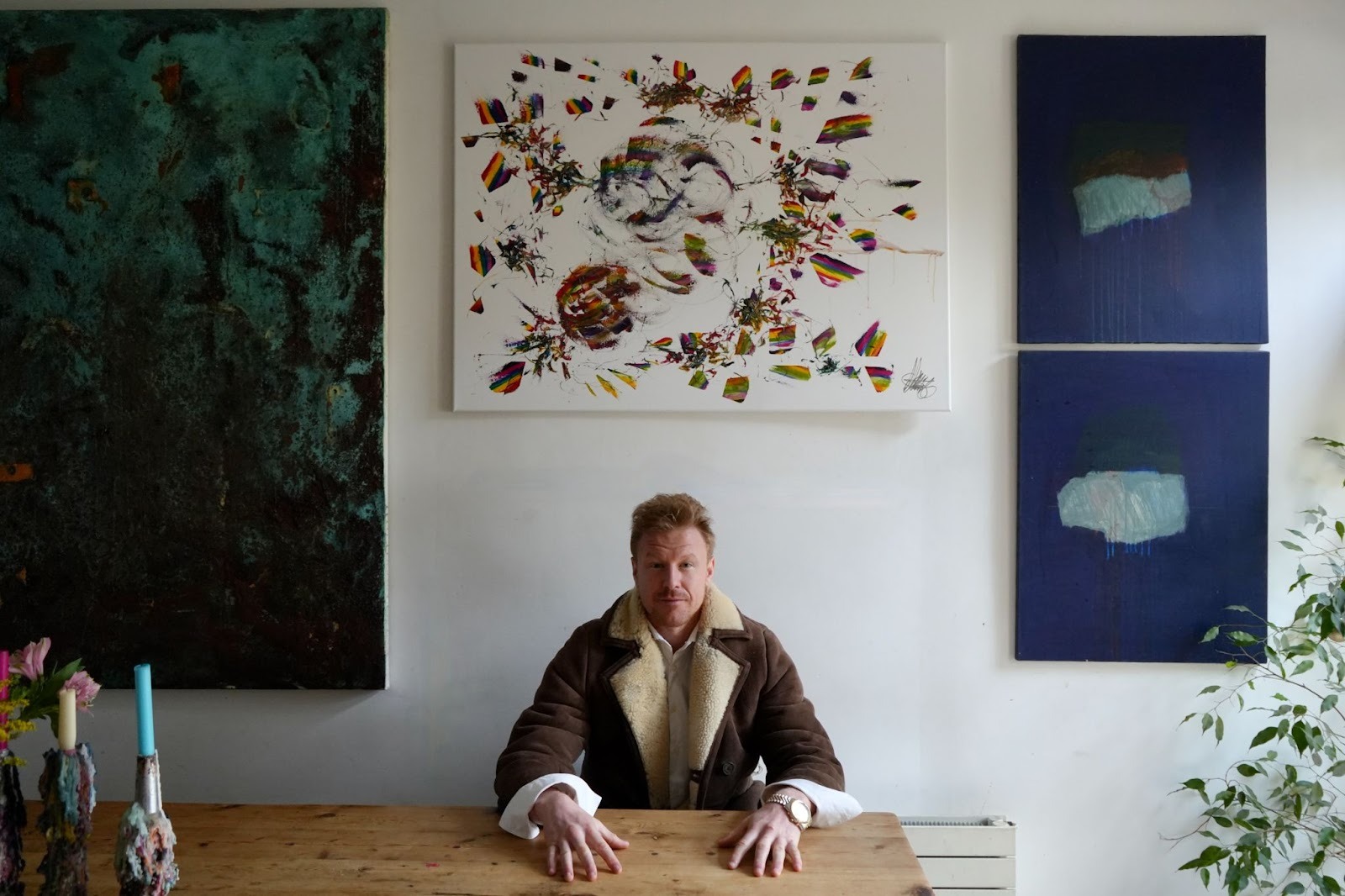
Nathan McAdam Freud is a South East London-born artist, poet, endurance athlete, and CEO of FreudInc, who has raised tens of thousands of pounds for charity since leaving rehabilitation. He is the grandson of the late Lucien Freud, one of the most celebrated figurative painters in British history, and the son of Paul Freud, an accomplished master of the arts. Sigmund Freud, whose theories on the unconscious mind reshaped modern thought, sits further back in the lineage. Three generations of men who looked hard at what most people turn away from. Nathan adds a fourth.
Painted Into the Blood
Lucien Freud did not make pretty pictures. He made honest ones, portraits so raw and physically present that critics called them uncomfortable. His studio in Holland Park, perpetually layered with paint from floor to ceiling, became as famous as the work itself. His grandfather Sigmund had done something equally radical a generation earlier, convincing the western mind that what a person cannot say aloud lives in the body, in the work their hands make when language fails.
Paul Freud, Nathan’s father and an artist in his own right, recently gave Nathan a Parker ballpoint pen. Nathan keeps it at his desk and writes every poem with it. A small act, from one creative hand to another, in a family where making things has always been the primary language. Nathan asks only that each name be treated with respect rather than reduced to headline shorthand “Family is everything.” What he has built emerged independently, shaped far less by inheritance than by years spent with nothing but a plant pot and a gifted set of paints.
A Name You Have to Earn
Nathan did not arrive at his identity through inheritance. He arrived through survival. During the worst period of his addiction, he held onto a single plant. Detox at Equinox in Elephant Castle. Then a men’s rehab in Plymouth, where he heard people laugh for the first time in what felt like years and listened to birdsong through a window. Then that rehab shut down due to lack of funding, and the men were sent out. The nurses stayed anyway. Some were on their third overnight shift. One was pregnant. None were getting paid.
“I owe my life to some of those people,” Nathan said. “They taught me about service and giving back. My life had been about me, my selfish needs, and getting what I wanted.”
It was at another rehab, in a small room with a single bed, that a soldier from Inverness knocked on Nathan’s door. The man had done three tours in Ireland before Nathan was born. He had survived a suicide attempt in the forest behind his mother’s house, the branch snapping before the worst could happen. He came into rehab, and he and Nathan got clean together. One day, he looked at Nathan and said, “You’ve got a beautiful mind, Nathan. Do something.” Then he gave him pens and paints. David Skinner’s death followed shortly. Nathan carries him still. The fundraising, the racing, the canvases, all of it holds David’s name inside it.
The Studio, the Broken Brush, and the Fibonacci Sequence
Nathan’s practice began in that same small government-supported room, where using oils demanded a system. He had seen photographs of Lucien’s studio, paint covering every surface. Nathan’s version looked nothing like that. Then one afternoon, he pressed too hard, and a paintbrush snapped, sending oil paint onto the curtains. He had no money. He was frightened. He worked through it. From that day forward, he has painted with only the broken pieces of a snapped brush.
Each canvas begins with physical contact. Nathan holds it, turns it over, and smells it. He reads poetry aloud first, always William Wordsworth, then a second poet he is currently studying. He writes by hand on large watercolour sheets using the Parker pen his father gave him, filling the page before signing and turning it over to paint. The words give him a blank canvas that the oils then answer.
The structure underneath each painting follows a Fibonacci sequence, the same mathematical arrangement found in shells and galaxies. Nathan traces its origin in his practice back to a dark image: a glass pipe, burned black at the sphere, hovering like a dying planet. That sphere, sucking in all light, became the starting point. From it, a nucleus splits. Then two. Then the spiral outward, in an arc, toward something new. “It follows that order,” he said. “It’s a constant cycle from a new beginning that I was given.”
Racing and Giving, Every Year Without Exception
Since leaving rehab, Nathan has completed an Ironman event every year. Pembrokeshire Tenby, known as Facing the Dragon. Hamburg. Lanzarote. Every race runs with a JustGiving page attached. Every penny goes to charity. On September 12, 2026, he will face the Ironman Extreme at Black Lake in Montenegro, starting in a cold lake at 4 a.m., with a cutoff to earn the right to run the black trail route through the mountain peaks.
His charitable exhibitions have been held alongside BHMT, the Beer-Harris Memorial Trust, a mental health charity named partly after his godfather, who died of cancer, and partly after the charity chairman’s only son, who died at 21 in a car accident in Africa. Nathan has never once failed to donate 50 percent of his exhibition proceeds.
When asked to offer one sentence that captures his life right now, he did not pause long. “I’m here for you. I love you. Everything’s going to be okay.” He says it to himself every morning. He says it mid-race. He paints it into the structure of every canvas. And through FreudInc, through competition, through another poem on another watercolour sheet in Peckham Rye, he says it to whoever needs to hear it next.