

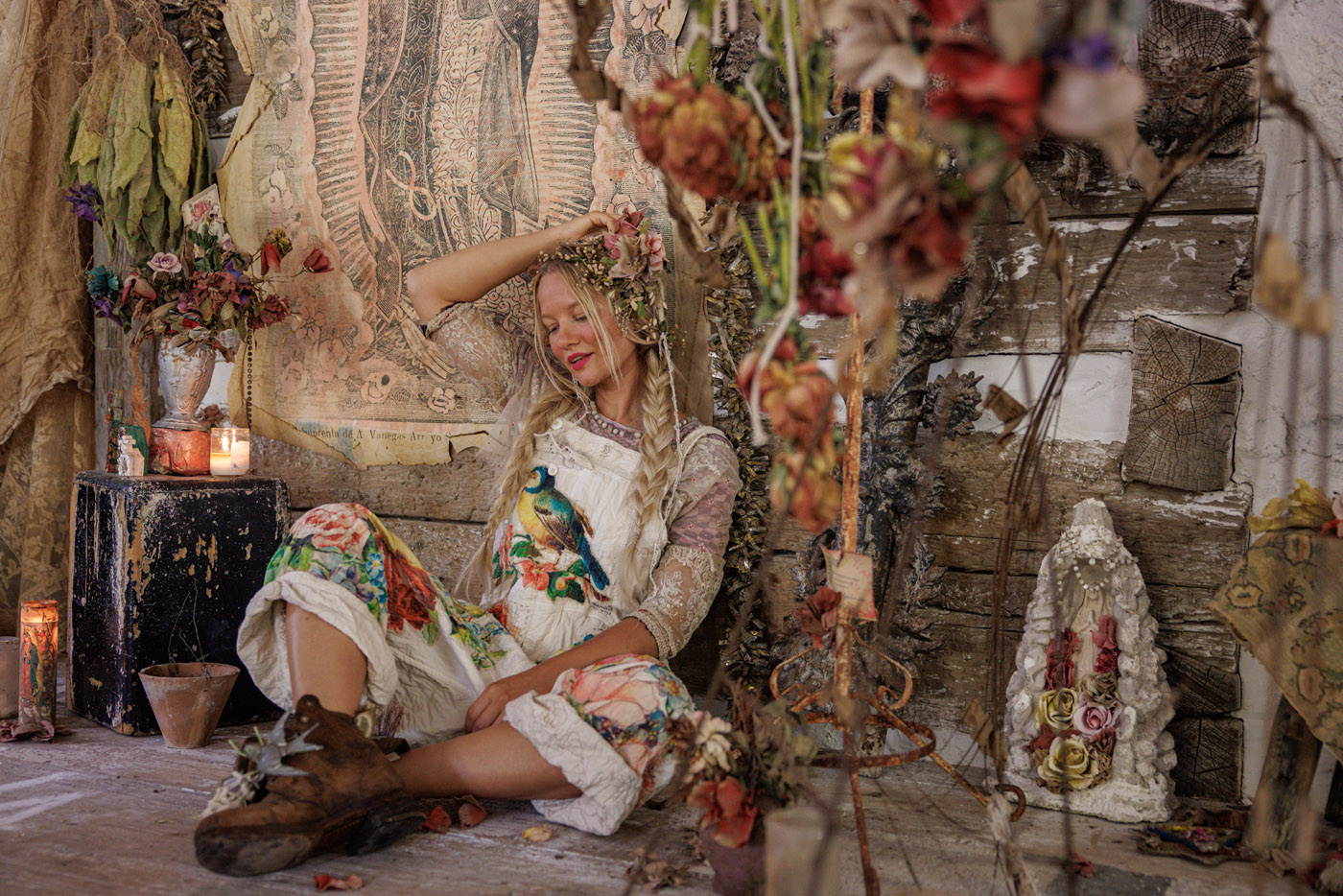
Forget the photographs for a moment. The photographs flatten it. A Magnolia Pearl coat in person is something else — the patchwork has depth, the different fabrics catching light differently, the sashiko-style stitching sitting proud of the surface rather than disappearing into it. The visible mend on the hem is not subtle. It was never supposed to be. You are meant to see exactly where the damage was and exactly what was done about it.
This is the central aesthetic fact of the brand, and it is also the reason Magnolia Pearl pieces behave so differently from other fashion in the secondary market. The garments look like what they are: objects made by hand, repaired by hand, and improved by both. They do not conceal their history. They are structured around it.
Robin Brown, who founded Magnolia Pearl in Fredericksburg, Texas in 2002, grew up repairing things out of necessity rather than preference. The visible mending that defines every piece she makes — the patchwork over worn fabric, the deliberate stitch over the frayed hem, the paint applied by hand to aged denim — is a direct translation of that upbringing into aesthetic terms. It holds that the repair is not an apology for damage. The repair is the most interesting part.
The aesthetic as argument
This is a counter-argument to the dominant logic of high fashion, which spends considerable energy making newness look effortless and age look like failure. Magnolia Pearl goes in the opposite direction. A piece from an earlier production run, worn for a decade by someone who understood what they had, arrives on the resale market as something richer than it was when new. The handling shows. The additional mending that a careful owner has added over years is not a defect. It is an addition to the piece’s biography.
Collectors have absorbed this logic completely. Magnolia Pearl garments resell at double and triple their original retail prices, a pattern sustained not by marketing campaigns but by a community of buyers who have learned to read the garments the way Brown intended: as objects whose value deepens with time rather than diminishes.
Why it sustains the giving
The aesthetic is not separate from the philanthropy. The collector market that has built up around Magnolia Pearl’s visual language — the visible repair, the patchwork, the handmade surface — is the financial basis for the Magnolia Pearl Peace Warrior Foundation, the brand’s registered 501(c)(3) nonprofit established in 2020.
Magnolia Pearl Trade, the brand’s authenticated resale platform launched in 2023, routes every third-party seller fee and 25% of exclusive auction proceeds directly to the Foundation. The Foundation has received more than $550,000 since its establishment. GuideStar filings record $268,293 in verified grants in 2024. The causes — housing for Indigenous American veterans, care for the animals of people experiencing homelessness, arts education for children in under-resourced communities — reflect Brown’s own biography.
The brand sells through more than 350 boutiques worldwide, including through Free People, and operates two flagship stores — in Fredericksburg and at the Malibu Country Mart in California. Taylor Swift wore the label during the folklore era without arrangement. Whoopi Goldberg on television. Blake Lively on screen. The people drawn to Magnolia Pearl tend to share a quality: they are looking for something that carries meaning in its surface, not just in its label.
That is what the visible mending achieves. Not just a counter-fashion statement, though it is that. A value proposition for collectors, and through collectors, for a nonprofit doing work that has nothing to do with fashion and everything to do with what Brown has always believed the work is for.
In 2024, Brown published Glitter Saints: The Cosmic Art of Forgiveness, a memoir that traces the aesthetic philosophy to its origins — the childhood repairs, the found materials, the conviction that beauty and honesty are the same thing. The book makes the connection between the garments and the giving explicit for anyone who had not already seen it in the stitching.
More at magnoliapearltrade.com