

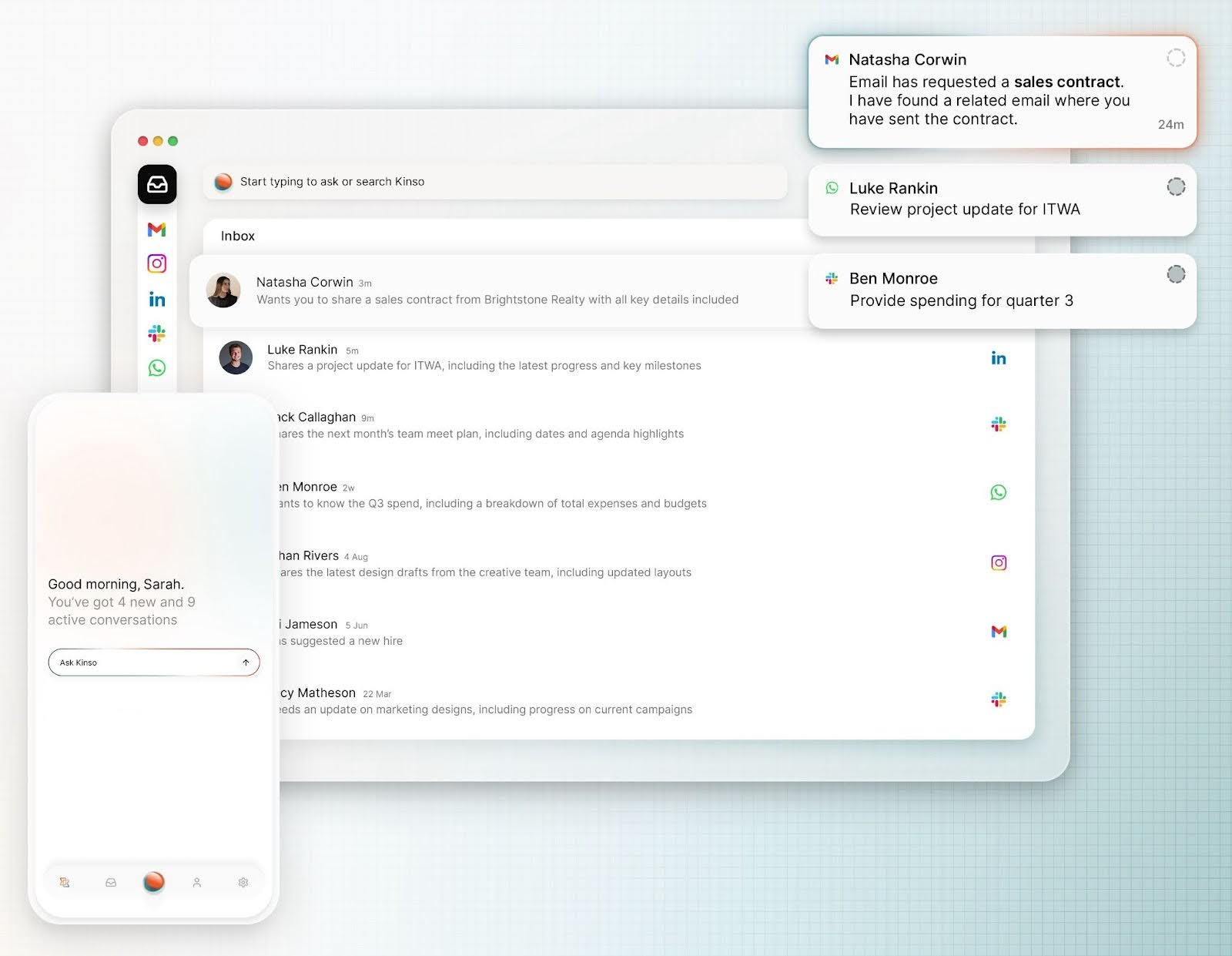
On a Tuesday morning in Sydney, a founder opens her laptop and skips the usual ritual of tapping through email, Slack, WhatsApp, and LinkedIn. Instead, she looks at a single column of conversations, already ranked: investor note at the top, customer risk below, a quiet hiring lead third. Each thread pulls in fragments from different apps, as if someone stitched her workday together overnight. That “someone” is Kinso, the still‑private app built by brothers Frank and Jacques Greeff, and the question quietly circulating in founder circles is simple: why has this unlaunched product become the one tool everyone seems to be waiting for?
The basic facts are straightforward. Kinso is an AI‑driven universal inbox that connects to email, chat, and social platforms, then reshapes the flow of messages into what the team calls an “opportunity stack.”
It is headquartered in Australia but aimed at a global class of operators whose jobs are defined by fragmented communication and scarce time. The timing is not accidental. Message volume is exploding, venture capital is tighter, and many leaders feel they are losing deals, hires, and relationships not for lack of effort, but because critical messages arrive in the wrong place, at the wrong time, with too little context.
What sets Kinso apart, and makes it profile‑worthy, is not only what it builds but how and why. The Greeff brothers are second‑time founders coming off a large exit, choosing to spend their next chapter attacking what looks, from a distance, like the most mundane part of modern work: the inbox. Their answer to the five W’s and the “how” tells a story about ambition, attention, and the changing expectations of the productivity stack itself.
From Exit Windfall To Unfinished Problem
Like many second acts in technology, Kinso begins with a contradiction. After selling their real‑estate technology firm for a life‑changing sum, the Greeffs could have become investors who lived on other people’s cap tables. Instead, they went back to the whiteboard to talk about unread messages.
During the scale‑up years, they watched critical deals hinge on seemingly minor exchanges: a casual LinkedIn introduction, a late‑night WhatsApp follow‑up, a Slack thread that never made it into email. They began to suspect that their success owed as much to luck in catching those signals as to any grand strategy.
Out of that suspicion came a more pointed question: what if, in the next decade, missing the right message becomes the most expensive mistake a founder can make? The brothers started cataloging every way communication had splintered since their first company began. Investor updates, hiring threads, customer complaints, partnership feelers, internal debates, board questions—almost none of it stayed in a single channel.
Each app had its own search, its own notification logic, its own blind spots. No one tool could say, with confidence, “Here is everything that matters about this deal, this person, this decision.”
Kinso is an attempt to build that tool. Rather than launch another email client or CRM, the team framed the problem as one of attention routing. They asked what an ideal day might look like for a founder or chief of staff if all channels could be treated as parts of the same conversation. The picture that emerged was not an empty inbox, but a short, ranked list of decisions, backed by a memory far better than most humans can sustain. The product they began to design is, in essence, a way to turn scattered conversations into a living map of leverage.
The choice to focus on this problem after a major exit is revealing. It signals that the brothers see communication not as a solved layer, but as the unfinished foundation of modern work. In a business culture that prizes moonshots and new categories, Kinso’s bet is almost unglamorous: if you help serious people stop losing what already matters, you do not need to invent a new kind of work. You just need to make the existing kind less wasteful.
Building An “Opportunity Stack” Instead Of An Inbox
At the core of Kinso is a simple but demanding idea: treat every message as data, and every thread as part of a graph. In practice, that means connecting to email, chat, and social accounts, ingesting messages into a unified store, and then looking for links between them. A contract discussed over email, a clarification sent later in Slack, a nervous question from the client on WhatsApp, and a note about the same account in a calendar event all become facets of one relationship, not four unrelated blips.
Once messages are stitched together this way, the familiar inbox metaphor starts to look inadequate. Kinso’s interface is less a list and more a ranked stack. At the top are conversations that appear to have the highest potential impact: a time‑sensitive investor concern, a strong candidate at risk of going cold, a customer hinting at churn, a partnership inquiry that matches a known strategic priority. Lower down sit routine updates, FYIs, and notifications that can wait, or never be opened at all. The user still sees everything, but attention is pulled toward where it is likely to matter most.
Around this stack, Kinso layers tools that treat context as a first‑class citizen. Users can ask, in plain language, to see everything discussed with a particular person about a particular topic over a chosen time frame.
Before a meeting, the app can surface a short briefing: last commitments, unresolved questions, key personal details, and relevant documents, regardless of where they were originally sent. When a new message arrives that clearly contains a request (“we’re searching for a senior iOS engineer,” “we’re considering a bridge round,” “we need to revisit pricing”), the system can cross‑reference the user’s network and history to suggest the right person to bring in, along with a drafted introduction.
This is where Kinso’s aspirations stretch beyond productivity into something closer to decision infrastructure. The app is not simply trying to make it faster to reply; it is trying to make it harder to miss the moments when replying matters. In doing so, it reflects a shift in the industry. The past few years of AI hype have been dominated by tools that generate content. Kinso belongs to a different emerging class: tools that sit quietly in the background, reordering reality so that humans can spend their limited judgment on the right problems.
That ambition brings obvious challenges. Ranking importance is not a neutral act; it encodes assumptions about what counts as “impact.” Kinso’s team has chosen to tune its models for founders and operators, weighting signals like hiring, capital, revenue, and relationship health more heavily than generic engagement.
That makes the software feel more relevant to its target users, but it also narrows the product’s initial scope. The company is betting that depth for a demanding niche will matter more than broad but shallow appeal.
A Waitlist As Signal, Not Spectacle
If Kinso’s internal logic explains why the product exists, its external reception explains why it is being called “the most anticipated app in the productivity stack.” Before opening public access, the team invited a small cohort of founders, investors, and chiefs of staff from a growing waitlist. They shipped updates weekly, sometimes more, and narrated their progress in public: new integrations, failed experiments, redesigns that did not land, performance issues surfaced by real‑world usage.
This “build in public” strategy has served multiple purposes. It has generated attention and a sense of narrative momentum, but it has also turned the waitlist into a rolling focus group. Prospective users can see the product evolving and can watch the founders respond to criticism without the veneer of press releases. For a tool that asks for access to sensitive communications, that visibility is not just marketing—it is part of how trust is earned.
The attention comes with pressure. When a product becomes a kind of promise, expectations rise faster than headcount. Kinso operates with a compact team compared to the giants building similar features into email suites and collaboration platforms. Its edge, if it has one, lies in speed of iteration and clarity of purpose: it exists to help a specific kind of user rescue signal from noise. If it drifts into general‑purpose feature creep, it will lose the focus that makes it interesting.
The brothers seem acutely aware of this trade‑off. In their public remarks, they avoid framing Kinso as a cure‑all. They do not claim to reduce message volume or to end context switching entirely. Instead, they return to a narrower promise: to make it far less likely that a high‑stakes conversation goes unseen, and far easier to act with full context when it appears. It is a modest claim on the surface, but underneath lies a redefinition of what a “productivity app” is for.
In that sense, Kinso’s distinct situation in its industry is less about hype than about the problem it chooses to take seriously. Most productivity tools try to help people do more. Kinso’s quiet heresy is to help people stop losing what they have already earned: the introduction, the deal signal, the subtle warning, the chance to be on time with the right reply. In a world where careers can turn on who answers whom, and when, that may be the one promise that justifies all the anticipation.