

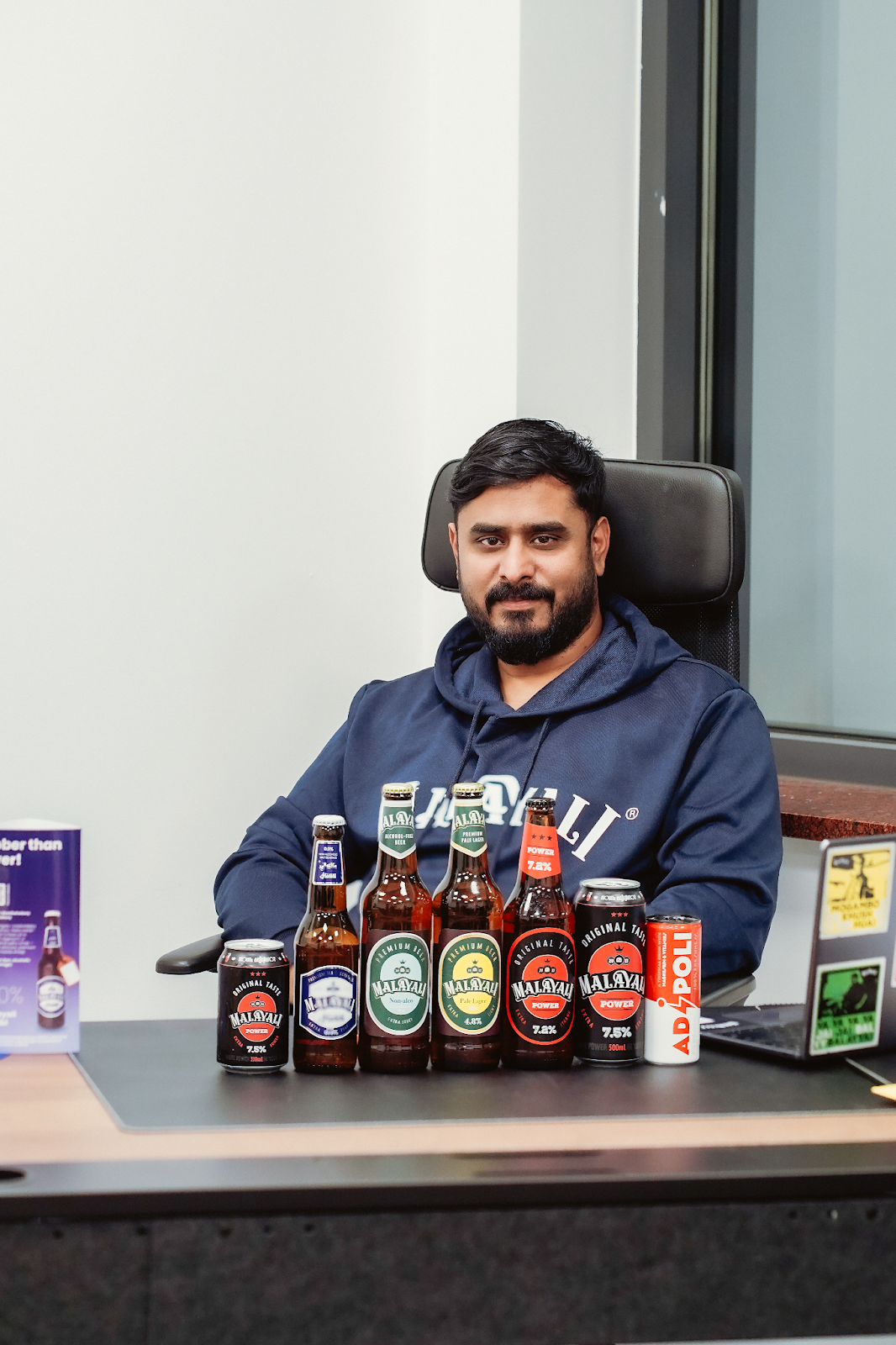
Malayali Beer did not storm the global market with a manifesto or a splashy campaign. Its presence has traveled quieter than that. Over three years, the brand has grown across Europe, the Middle East, Southeast Asia, and Oceania. It slid onto bar tops, retail shelves, and airport duty-free displays without asking drinkers to rethink lager. The product handled that work on its own.
The beer comes from Hexagon Spirits International, a Poland-based company founded by Chandramohan Nallur. Malayali Beer now pours across 25 countries. It has crossed one million cans in sales and earned Gold and Bronze medals at the World Beer Awards 2025. None of that belonged to a master plan. The beer began as a response to a shipping crisis, and the “zero burp” reputation it carries grew from thousands of candid talks at dinner tables around the globe.
“I didn’t start with an idea to redefine lager,” Nallur said. “We were dealing with a supply problem and tried to make something workable from what we had.”
That plain-spoken beginning now sits at the heart of a larger shift in how lager is brewed, sold, and enjoyed.
A Lager Shaped by Circumstance
Malayali Beer emerged when global supply chains buckled. Early in the Russia-Ukraine war, shipments across Eastern Europe stalled. Nallur’s company was left holding 20,000 kilograms of Indian rice flakes that could not reach their planned market. Rather than swallow the loss, his team and co-founder Sargheve Sukumaran, a design strategist and entrepreneur, ran an experiment. Could they weave the grain into a beer brewed with Czech-style methods and European hops?
“We were just trying to turn a bad situation into something less bad,” Nallur recalls.
The result was a hybrid lager that felt different from established European brands. Drinkers called it smoother, especially with food. Some noticed the absence of bloating they linked it to other lagers. Others pointed to a clean finish free of gassy heaviness or the awkward post-beer burp most people accept as the price of a pint. These reactions were never part of the design brief, yet they proved consistent enough to matter.
“We didn’t go looking to solve a consumer problem,” Nallur said. “But when people in different countries keep telling you the same thing, you pay attention.”
Trials inside partner breweries backed up the pattern. When those rice flakes met European malt and hops in the right balance, the lager stayed crisp on the tongue yet felt gentle alongside food. Customers who paired the beer with biryani, kebabs, pierogi, or rich gravies described a strange absence of noise and sluggishness. The drink slipped under spicy flavors rather than clashing with them. Research on adjunct grains such as rice supports these findings, pointing to lighter body, lower protein load, and a cleaner finish that curbs how gas builds after drinking.
Malayali Lager became the top seller across Europe, marketed as “probably the smoothest lager in the world”. Malayali Power, a stronger variant, gained ground in the Middle East and Southeast Asia. Malayali Habibi, the alcohol-free option, reached markets with tighter rules or shifting drinking habits. Together, the three products treat lager less as a rigid category and more as a flexible format.
Rethinking What Lager Delivers
Lager has long been defined by consistency. Its pull rests on clarity, familiarity, and a taste people can predict. Malayali Beer keeps those traits but reframes them. The brand stresses how well the beer pairs with meals and how it feels in the body, rather than purity of origin or loyalty to one brewing school.
“We think a lot about how beer behaves with food,” Nallur said. “That sounds simple, but it changes how you build the recipe.”
Restaurant owners in Poland and beyond saw a clear impact. Diners who usually stopped at one heavy beer during a meal felt at ease ordering a second Malayali Lager. They reported that the drink stayed kind to their stomachs. Review sites and social media echoed the same line. Smooth, food-friendly, and gentle hours later, drinkers said. The “zero burp” label took shape at those tables. Drinkers repeated it long before any marketing team picked it up.
The appeal goes deeper than comfort. Plenty of cultures view public burping as rude or childish, especially at formal meals. A beer that lowers the odds of that awkward moment hands drinkers a sense of control and grace that tasting notes never mention. Nallur puts it plainly. “Beer should walk beside life, instead of cutting into it,” he says. “If your drink pushes you away from the table or leaves you uneasy, something is off.”
The approach sets Malayali Beer apart from brands such as Kingfisher and Cobra, which have long served as Indian-origin lagers on the world stage. Unlike those names, Malayali does not lean on heritage or nostalgia. It nods to Kerala and diaspora, but its identity stays fluid on purpose.
“Malayali is about movement,” Nallur said. “People move, tastes shift, and products need to make sense in more than one place.”
Growth Without Noise
Hexagon Spirits runs a distributed model. It partners with brewers and distributors region by region rather than sinking money into huge central plants. The setup let the company scale fast without the heavy spending typical of beverage makers. It has cut the brand’s risk if any single market falters.
Within two years and nine months of launch, Malayali Beer passed one million cans sold. Yearly revenue now sits at roughly 1.3 million euros, with reported growth near 600 percent. Shelf space in three major airport duty-free zones has lifted brand awareness among travelers who often sample beers outside their home markets. BBC World News featured the brand, carrying its story to viewers well past the Indian diaspora.
Awards arrived on a quiet note. Malayali Lager claimed Gold at the World Beer Awards 2025. Malayali Habibi took Bronze. The medals worked less as a marketing prop and more as outside proof.
“We didn’t change anything because of the awards,” Nallur said. “But they confirmed that what we were doing made sense beyond our own thinking.”
The Sober Strategist Behind The Brew
One of the lesser-known facts about Malayali Beer is one of the most striking. Nallur is a teetotaler. He never drinks alcohol.
He treats that distance as a working edge rather than a gap. Without personal taste guiding his calls, he leans on consumer feedback, distributor data, and market trends. The gap shaped the company’s push into non-alcoholic drinks, a space growing fast worldwide. While rivals tweaked recipes by palate, Nallur kept asking what happened after the final sip. Did the beer sit well with spicy food? Did drinkers walk away light on their feet or dragging a weight? Would they order a second round, or did one glass feel like a full meal?
“Being a teetotaler keeps my head cool,” he says. “I don’t romanticize the product. I study what it does to people’s bodies and moments.”
Sukumaran balances that calm analysis with a designer’s eye. He weighs how Malayali looks on the shelf and reads at the table, from the typeface and color down to the spark someone feels when spotting the word “Malayali” on a tap halfway across the globe. “We are selling the confidence that a beer from a Malayali founder can stand beside any global brand on quality,” he notes.
Their combined outlook has helped the company move through varied rules and cultural norms, especially in regions that restrict alcohol. Malayali Habibi’s reach in the Middle East hints that Lager’s future may stretch past alcohol entirely.
What Quiet Redefinition Looks Like
Malayali Beer pursues something gradual rather than grand. It puts forward the idea that lager can be lighter without being flat, global without being bland, and flexible without losing shape. The next chapter will test if that thinking holds at a greater scale. Plans call to enter North America, Africa, and China, markets packed with different tastes and fierce rivalry. Each new region brings fresh hurdles in regulation, supply, and flavor expectation.
Nallur meets those hurdles with the same logic that first turned stranded grain into a new lager. “Every time something breaks the way you expect, you learn what it was really meant to achieve,” he said.
Revenue has jumped several hundred percent since launch. Annual turnover clears the seven-figure euro mark. Expansion tracks back to the same quiet vow that began on a blocked shipping lane. A lager that honors the drinker’s body as much as their palate may yet show millions more beer lovers that the smallest, least-talked-about irritation at the table was never something they had to live with.