
Skylark Labs, an artificial intelligence (AI) company specializing in adaptive edge computing, has announced a $21 million, three-year contract to deploy its Kepler™ AI traffic enforcement technology across 6,000 police systems in a major Asian nation. The agreement represents one of the region’s largest known deployments of self-learning traffic AI, marking a key step in the company’s expansion into Asia’s mobility and public safety markets.
Skylark Labs, founded in 2021 by CEO Dr. Amarjot Singh, develops adaptive AI systems that can learn and update in the field. The new contract establishes the company as a leading provider of edge-native enforcement technology in Asia, at a time when investments are being made in digital infrastructure and intelligent transportation systems.
Kepler™ And The Need For Adaptive Traffic AI
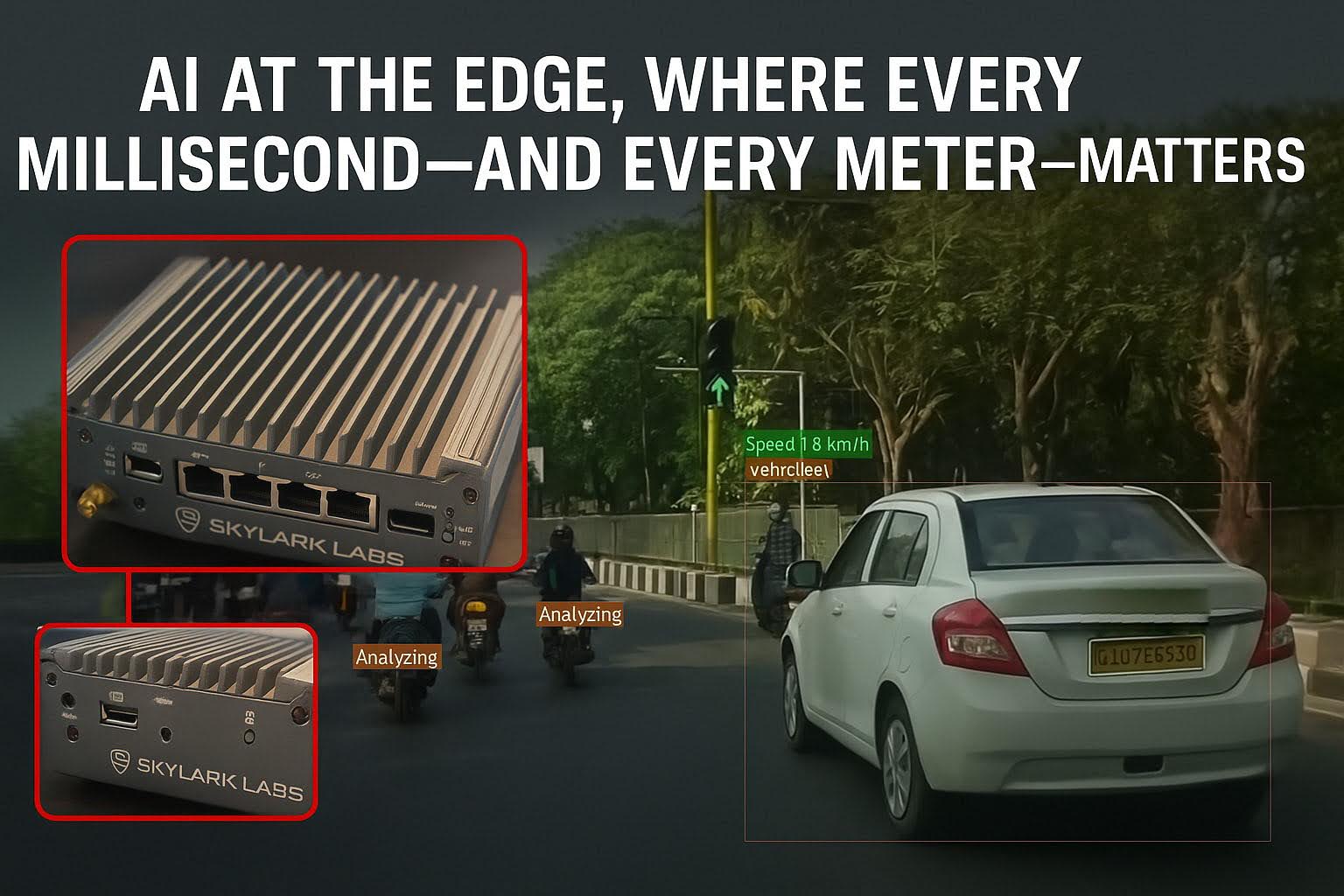
The Kepler™ platform is designed to run directly on patrol vehicles and roadside units, providing real-time detection of traffic violations and risk behaviors without relying on constant internet connectivity. By focusing on on-device processing and continuous learning, the system seeks to help agencies improve road safety while keeping recurring operating and data transmission costs manageable in fast-growing, infrastructure-constrained environments.
The Kepler™ deployment addresses a growing concern among traffic authorities: AI systems that perform well at launch but gradually lose accuracy as road conditions, fleets, and driver behavior evolve. Conventional traffic AI typically depends on centralized retraining and software updates, which can be costly and slow to implement across large fleets. In many emerging markets, limited bandwidth and uneven connectivity make it challenging to sustain continuous cloud dependence.
Kepler™ is built as an edge-native platform to address these challenges. Each equipped patrol car or roadside unit runs multiple AI models that process video and sensor data locally, detect violations such as speeding and illegal turns, and generate structured events that integrate with existing records and ticketing systems. A monitoring layer evaluates the performance of these models in real time and looks for signs that the system is encountering unfamiliar vehicles, road layouts, or traffic patterns.
It processes data directly on vehicles and fixed units, allowing operations to continue during network outages and reducing the need to stream large volumes of raw video to central servers. This edge-based design also keeps most sensitive data on-device by default, aligning with stricter privacy expectations and emerging data protection frameworks across the region.
“When agencies deploy traffic AI, they often do not see when performance starts to drift,” says Dr. Singh. “Kepler™ has been engineered to monitor its own accuracy and adapt on the device, so agencies can keep their systems aligned with what is actually happening on the road, instead of what the model saw a year ago in training.”
Self-Learning Architecture And Market Position
Kepler™ uses a multi-layer architecture that combines detection with self-assessment. The primary model identifies violations and risky behaviors, while secondary models monitor performance and identify potential knowledge gaps. When the system encounters unfamiliar scenarios, it can update parts of the model locally using onboard compute resources, without waiting for central teams to push a new version.
This capability is based on research conducted by Dr. Singh during his work with the United States Defense Advanced Research Projects Agency’s Lifelong Learning Machines program, as well as his academic roles at the University of Cambridge and Stanford University. This study describes Kepler™ as an example of AI that can recognize when it is uncertain and adjust, a feature they consider essential in environments where conditions change frequently.
“The long-term value here is not only about one contract,” notes Dr. Singh. “It is about showing that AI systems used in public safety can maintain and even improve their accuracy over time in the field, instead of quietly degrading and forcing agencies into expensive replacement cycles.”
Significance For Asia’s Traffic Management Efforts
The $21M contract places Skylark Labs at the center of an effort to modernize traffic management in one of Asia’s fastest-growing vehicle markets. The 6,000-system rollout is expected to cover high-traffic corridors and urban areas where manual enforcement has struggled to keep pace with rising volumes and complex mixed traffic.
Authorities aim to utilize Kepler™ to expand coverage, standardize violation handling, and enhance data quality for informed policy and planning decisions.
Dr. Singh believes that the adaptation of its self-aware AI technology extends beyond traffic enforcement to any application where conditions change over time. This adaptive AI’s potential can transform public safety applications beyond traffic enforcement, including automotive, defense, and even infrastructure.
He adds, “This agreement shows that traffic agencies in Asia are ready for AI that can stand on its own in the field. They want systems that respond in real-time, learn from what they see every day, and maintain accuracy a year after deployment. We are happy to be part of this innovation and investment.”
About Skylark Labs
Founded in 2021 by Dr. Amarjot Singh, Skylark Labs develops adaptive artificial intelligence (AI) systems designed to learn, evolve, and operate autonomously in real-world environments. Headquartered in New York City, the company delivers next-generation AI solutions for mobility, public safety, and critical infrastructure applications.
Skylark Labs specializes in brain-inspired AI that continuously adapts to new challenges without requiring pre-training or constant connectivity. The company aims to pioneer embodied AI that seamlessly integrates into physical devices while evolving toward true general intelligence.
Contact Information
Contact person: Dr. Amarjot Singh
Company: Skylark Labs
Email: amarjot@skylarklabs.ai
Website: https://skylarklabs.ai/