

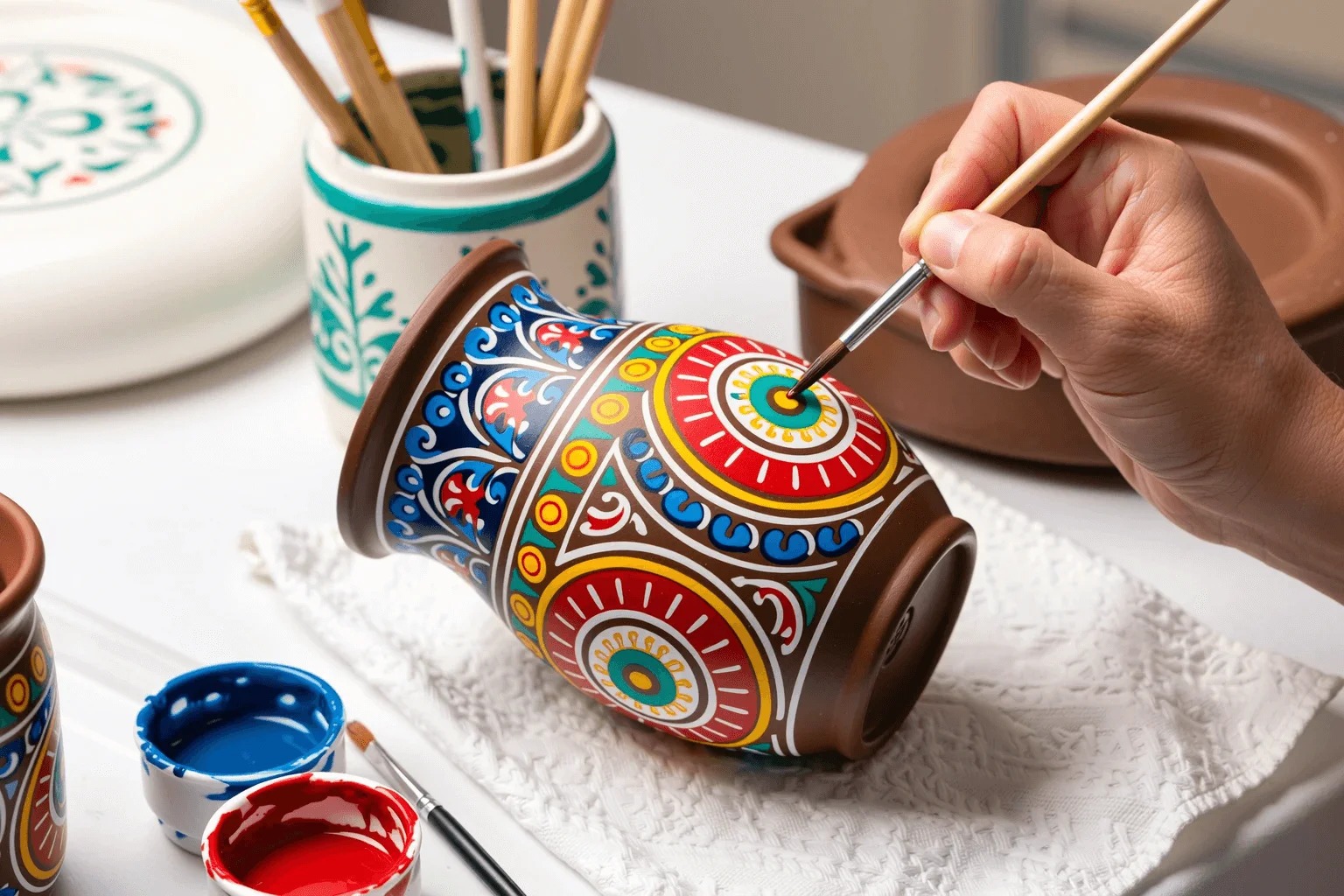
Mahendra Sah Rauniyar does not paint to decorate. He paints to argue — with history, with geography, with the slow erasure of living cultures in a world that often mistakes antiquity for irrelevance. A Mithila artist with an international footprint, Rauniyar has spent years working at the intersection of traditional visual grammar and the demands of a contemporary global audience.
His work carries the geometric precision and spiritual density that define Mithila art, a tradition rooted in the plains of Nepal and northern Bihar, India, where women once drew auspicious symbols on mud walls to mark marriages, harvests, and the passage of seasons. Yet Rauniyar pushes that tradition further, demanding that it occupy new spaces, new conversations, and new economies.
A Living Tradition, Reimagined
Mithila art is among the most visually distinctive folk traditions in South Asia. Its origins trace back centuries. Some accounts link it to the wedding of Ram and Sita, when King Janak of the Mithila kingdom ordered the walls of homes to be painted as a welcome. For generations, women passed these techniques from mother to daughter, working in rice paste and natural pigments, their canvases the mud walls of homes and the floors of courtyards. Green came from bean leaves, yellow from turmeric, and black from cooking smoke.
What makes Rauniyar’s position unusual is the tradition he entered. Mithila art has historically been the domain of women, and male practitioners remain a small minority. To work within it is to accept that weight — the gender history, the caste hierarchies embedded in the visual vocabulary, the question of who gets to carry a tradition forward, and who simply borrows from it. Rauniyar’s answer is to carry it seriously: studying its deep codes, honoring its iconography of fish, peacocks, elephants, and lotuses, then extending those symbols into commentary on the world as it exists now.
From Village Walls To Global Stages
The migration of Mithila art from earthen walls to paper, canvas, and cloth has been one of the quiet revolutions of South Asian cultural history. What once lasted only as long as monsoon rains allowed has now found its way into galleries across Europe, North America, and Asia. Rauniyar has moved with this tide, exhibiting internationally, bringing the art form to audiences who might otherwise know nothing of Janakpur, nothing of Maithili culture, nothing of the Terai plains where this visual language was born.
His practice as a cultural strategist goes beyond the canvas. Rauniyar understands that the survival of Mithila art in the twenty-first century depends not only on gifted painters, but on the infrastructure that surrounds them: access to markets, the ability to speak across cultural distances, and the economic frameworks that allow artists to sustain their work without compromising it. A creative economy built around Mithila art — one that generates income, recognition, and institutional support for its practitioners — requires someone willing to work as both artist and architect of that system. Rauniyar has taken on both roles.
The Weight Of Visibility
There is a particular pressure that comes with representing a tradition on an international stage. Every brushstroke carries context that most viewers will not immediately read. The concentric geometric borders, the iconic two-fish motif, the stylized depictions of deities — these are not decorative choices pulled from a visual lexicon at random. They are a language, precise and historically loaded. To present this language abroad is to translate, and every translation risks loss.
Rauniyar’s response to that risk is rigorous fidelity combined with the freedom to speak from the present. His works engage with Mithila’s visual heritage on its own terms, not as a museum artifact, but as a living mode of thinking and seeing. Younger artists and cultural workers across Nepal and India have watched his trajectory, recognizing in it a model for how a regional art form can claim global relevance without hollowing out what makes it distinct.
The global appetite for authentic, hand-crafted visual traditions has never been stronger, yet the artists who carry those traditions rarely benefit proportionally from it. Rauniyar’s work in the creative economy addresses that gap directly by building bridges between the labor of Mithila artists and the markets, collectors, and institutions that value their work. It is unglamorous, strategic work, and it matters as much as the paintings themselves.